
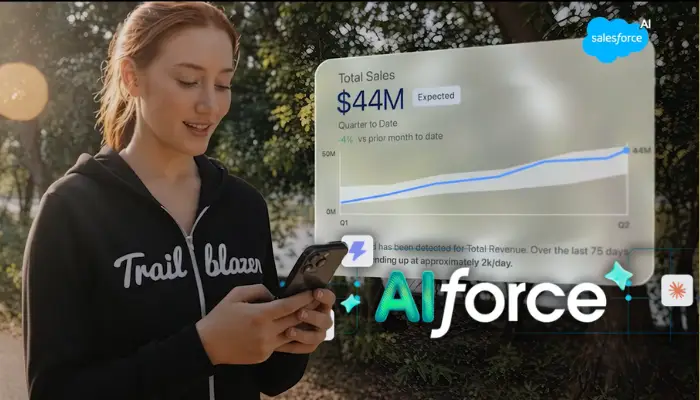
Singapore – Salesforce has introduced AIforce, a new interface layer designed to extend the company’s platform data, workflows and business logic into external AI tools such as Claude and Slack, according to the company.
The launch, announced on 16 September 2026, is aimed at allowing employees and AI agents to access Salesforce’s enterprise knowledge without opening the Salesforce application itself, the company said.
Salesforce described AIforce as a system that lets users build customisable, “live” interfaces on demand rather than relying on fixed dashboards and layouts.
According to the company, most of an organisation’s data has historically lived inside Salesforce but has only been accessible through its native user interface, limiting who could use it and how much value could be extracted from it.
With AIforce, Salesforce said employees who have never used a Salesforce dashboard will be able to ask questions, update records and trigger workflows directly from platforms such as Claude, Slack or Salesforce’s own Lightning interface.
The company added that AI agents built on the new layer can read across large volumes of records simultaneously, connect to external systems, and take action while working from a complete view of business data.
“AI is creating an interface revolution,” said Marc Benioff, Chair and CEO, Salesforce. “We are combining model intelligence with all the context that customers have built into Salesforce to create an intelligent, dynamic, composable system that is securely governed, built with Zero Data Retention, and designed to work with the core systems that already run your business.”
Meanwhile, Salesforce said the tool carries particular relevance for Southeast Asia, where much business communication already happens through conversational channels.
“As a deeply mobile-first region where people work in conversational channels, ASEAN businesses can unlock the full potential of AI through AIforce. By bringing the trusted context, workflows, and governance of Salesforce straight into where work already happens, AIforce empowers employees to act on enterprise data in simple, natural language,” said Paul Carvouni, Senior Vice President and General Manager, ASEAN, Salesforce.
“This gives businesses across the region the speed and operational agility needed to capture growing domestic opportunities,” said Carvouni.
AIforce builds on what Salesforce calls its Agentic Enterprise architecture, which also comprises Data 360, a unified data and metadata layer; Customer 360, which provides business logic and process permissions; and Agentforce, the company’s existing suite of deployable AI agents.
Salesforce said AIforce is designed to operate within a company’s existing security permissions, meaning every request and resulting action is filtered according to what the requesting user is already authorised to see or do.
The company also confirmed that data processed through AIforce is used only to answer the query at hand and is not retained by the underlying AI model provider, a practice it refers to as Zero Data Retention.
Additionally, Salesforce said no new permissions structure, data migration or custom integration work is required for existing customers to adopt the feature, with administrators able to connect the system and grant team access immediately.
AIforce is launching alongside three initial integrations: Claudeforce, Slackforce and Agentforce Coworker, according to the company.
Claudeforce extends an existing partnership between Salesforce and Anthropic, embedding Salesforce data into a prebuilt MCP server inside Claude, the company said.
Salesforce said this integration, known as Salesforce in Claude, includes 37 prebuilt sales skills covering tasks from prospecting to pipeline management, and has already been piloted by companies including Deloitte, GitLab and Legora ahead of a wider beta rollout.
For developers, Salesforce added that a companion plug-in for Claude Code provides more than 40 further skills and access to the company’s broader skills library.
Slackforce, the second integration, embeds Salesforce data and workflows directly into Slack conversations, according to the company.
Salesforce said the update introduces Slackforce Surfaces, allowing teams to generate live, interactive views of data that colleagues can filter, discuss and act on collectively within Slack.
The company also pointed to Slackbot, an assistant capable of reasoning across both Slack conversations and Salesforce records to identify issues such as disengaged customer accounts and to draft follow-up actions automatically.
A related feature, Slack CRM, was also introduced to let users update Salesforce records and log notes directly from Slack without switching applications, the company said.
Salesforce further highlighted Slack Code, a collaborative coding tool designed to let teams work with an AI agent on a shared project within Slack, producing working code and documentation as output.
“We handle over 800,000 customer inquiries a year, so getting our people the right context fast is everything,” said Elia Wallen, Founder and CEO, Engine.
“Slackforce makes that possible — instead of waiting on someone else’s time and expertise to turn data into a dashboard or report, anyone on our team can just describe what they need and get a real, working interface back, built from data we already have, without ever leaving the conversation,” Wallen added.
The third integration, Agentforce Coworker, functions as an AI assistant embedded within Salesforce’s own Lightning interface, according to the company.
Salesforce said the tool operates within a customer’s existing permissions and business rules, and can call on previously built and deployed Agentforce agents to expand its capabilities over time.
The company reported that 100,000 users activated Agentforce Coworker within the first 35 days of its availability.
“Agentforce Coworker has been a game-changer for Fulton Bank,” said Brandon Bernard, Senior Vice President/Sales Technology Strategist, Fulton Bank.
“In just weeks, we went from zero to more than 20 use cases live in production, supporting approximately 3,000 users across the organisation. We’re already seeing substantial daily usage and real examples of how Coworker is helping teammates find information faster, prepare more effectively, and move work forward,” Bernard said.
Salesforce said AIforce is underpinned by what it calls the Headless Toolkit, an open architecture providing APIs, MCPs, plug-ins and developer tools for building customised AI experiences on the platform.
The company added that this architecture feeds into its AgentExchange marketplace, where partners including Anthropic, Amazon Web Services, Google and OpenAI, alongside firms such as Lovable, Vercel, Docusign, Gamma, Jasper, Ramp and Rippling, offer AI-related integrations and tools.
Salesforce said further platform integrations for AIforce are expected to be announced in the coming months.