

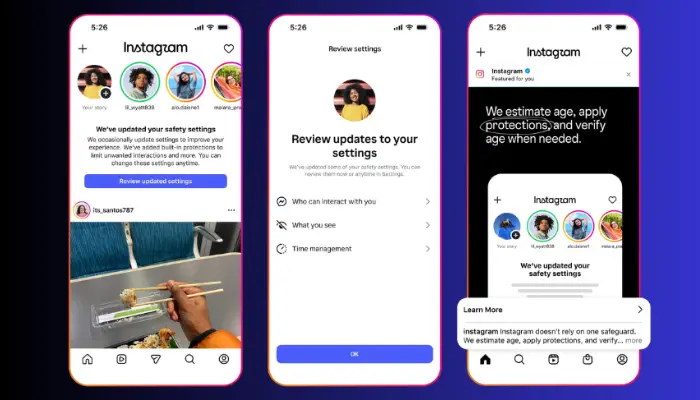
Singapore – Meta has expanded its AI age-estimation technology globally on Instagram, placing millions more teenagers into Teen Account protections even when they have entered an adult birthday.
The company said the technology identifies accounts it suspects belong to teens and moves them into age-appropriate settings. Meta said it has placed more teens in those protections since first introducing the system, which prompted the global rollout.
According to Meta, Teen Accounts on Instagram, Facebook and Messenger automatically limit who can contact teens, the content they see and the time they spend on the apps.
Philip Chua, APAC Director of Public Policy, Products at Meta, said, “We know parents across Asia want to feel confident about their teens’ experiences online. By expanding our AI age-estimation technology, we’re helping millions more teens receive Teen Account protections, even where an adult birthday has been entered. This builds on our ongoing work to give teens age appropriate experiences, with built in features that limit who can contact them, the content they see and the time they spend on our apps.”
Meta is continuing the rollout on Facebook, and it plans to begin launching similar technology on Threads later this year. The expansion follows the company’s recent agreement with 52 bipartisan attorneys general in the United States, which commits it to strengthen how it identifies teens and children under 13.
Meta acknowledged that confirming age remains an industry-wide challenge, because some teens misrepresent their age to access services they are too young to use.
Separately, parents in the United States will begin seeing an in-feed video on Instagram this month explaining how Meta places teens in age-appropriate protections. The video links to an article by Larry Magid, President and CEO of ConnectSafely, which outlines the company’s approach to age assurance and how parents can help ensure their teen’s age is accurate.
In Australia, Meta has started using Apple’s age-range signal as an additional method of understanding age. Parents who set up a smartphone for a teen can choose to have the app store confirm the user’s age and assign an age range, which Apple then passes to developers such as Meta each time the teen downloads an app.
Meta said it uses the signal voluntarily, but argued that teens will receive inconsistent protections while app stores and developers treat it as optional. The company has long backed legislation requiring age verification and parental consent at the app store level.
It said a single verified signal from devices, shared consistently with all apps, would be more effective and privacy-preserving than asking each platform to verify age individually. Meta added that its own age-estimation work could act as a backstop, correcting errors and feeding them back to the app store.
Meta also pointed to gaps in regulation. It said many new teen online safety laws do not explain how companies should determine a user’s age, with some requiring invasive checks for everyone and others offering no guidance.
Under the attorneys general agreement, Meta said it is investing in technology to catch accounts that may belong to children under 13. It is also strengthening the systems that identify accounts belonging to teens aged 13 to 17, including those that use an adult birthday.
Meta has also called on TikTok and YouTube to adopt the same practices, noting that Instagram is only one of many apps teens use.