

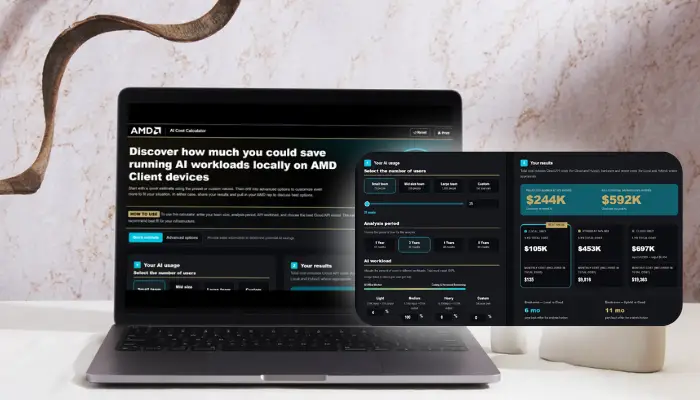
Singapore – AMD has introduced a new tool designed to help organisations compare the costs of cloud, local, and hybrid artificial intelligence deployments, as enterprises grapple with rising AI spend. The Tokenomics Calculator arrives at a moment when businesses across sectors are expanding their use of frontier models and agentic AI systems.
Enterprises that have scaled up AI usage over the past 18 months will likely recognise the pattern. Wider access, heavier use, and the rise of agentic AI tend to push costs upward rapidly. As more seats are purchased and usage is encouraged, token consumption climbs, monthly bills grow, and finance departments begin asking pointed questions about return on investment.
In response to this trend, AMD says the Tokenomics Calculator allows organisations to model three separate deployment scenarios: Cloud Only, Local (AMD), and Hybrid. The tool calculates total cost of ownership over one, three, four, or five years, alongside average monthly run rates for each deployment model.
It also determines the break-even point, meaning the month at which AMD hardware investment pays for itself relative to cloud-only spending. In addition, the calculator provides an automatically sized AMD hardware recommendation based on a company’s team size and workload tier.
According to AMD’s modelling, a medium workload tier — representative of a knowledge worker actively using an agent harness such as Claude Code, Codex, or Hermes — involves roughly 5.7 million input tokens and 574,000 output tokens per user per day. Under this scenario, a fleet of 500 AMD AI PCs deployed in a hybrid configuration, split 50% local and 50% cloud, can deliver projected three-year savings of between 40% and 60% compared with a cloud-only approach, depending on the cloud model used.
Full local deployment pushes potential savings even higher, with break-even typically achieved in under 24 months, AMD states. The calculator’s Hybrid Mix slider allows users to model precisely what percentage of token volume should run locally versus in the cloud, helping organisations identify an optimal split before committing to hardware investment.
Results, including a break-even analysis and hardware recommendations, can be exported to PDF for use in business case reviews.
The rationale behind the tool centres on how knowledge workers typically interact with AI systems. Prompts are usually drafted, tested, and adjusted before a final version is executed, and this iterative back-and-forth can consume a significant share of a task’s total token volume. That preliminary drafting stage does not require frontier-level model performance; instead, it needs to be fast, consistently available, and low in cost.
When this iterative work is routed entirely through a cloud API, organisations end up paying frontier-model pricing for what functions as a rough-draft scratchpad. Every rephrased prompt, every “make it shorter,” and every “could you try a different tone?” adds to the API bill.
A hybrid model, by contrast, allows organisations to apply the appropriate level of compute to each task without limiting employee access to cloud-based tools. Cloud services remain available for final prompt execution and complex reasoning, but at a lower overall cost than a cloud-only approach over time, according to AMD.
There is also a less visible cost tied to limited AI access within teams. Employees excluded from AI tools because licensed seats are full may be slower to adopt AI or to realise its benefits, even though this cost does not appear directly on an invoice.
Enterprise cloud AI contracts are typically structured around a fixed number of seats. Once those seats are filled, employees without a licence are unable to access AI functionality, and are left to wait, seek workarounds, or forgo the tools altogether. Given that AI-driven productivity is increasingly linked to competitive advantage, this kind of exclusion carries a real business cost, AMD argues.
Shifting workloads to local execution using AMD Ryzen™ AI and AMD Radeon™ products offers an alternative access route, the company says. Employees who would otherwise be excluded from cloud AI seats could instead use local inference for tasks such as drafting, summarising, analysing, and generating test code, without consuming a licensed seat or adding to the cloud bill.
For organisations with large employee populations that cannot justify seat licences for everyone, AMD positions local inference as a way to expand access without increasing cost.
More broadly, AMD frames the conversation around enterprise AI in 2026 as having shifted from capability toward sustainability. IT decision-makers want AI’s benefits delivered at scale, but increasingly require those benefits to remain financially viable.
For IT leaders, this means designing AI strategies that avoid breaching cost ceilings or restricting access purely to manage quarterly spend.
By removing the per-token cost associated with early-stage conversation and prompt refinement, local inference addresses one of the most token-intensive aspects of everyday AI use, according to AMD.
Ultimately, the company suggests that advances in both hardware and local models have made local AI deployment both practical and commercially viable, with the tooling and hardware required already available today.