

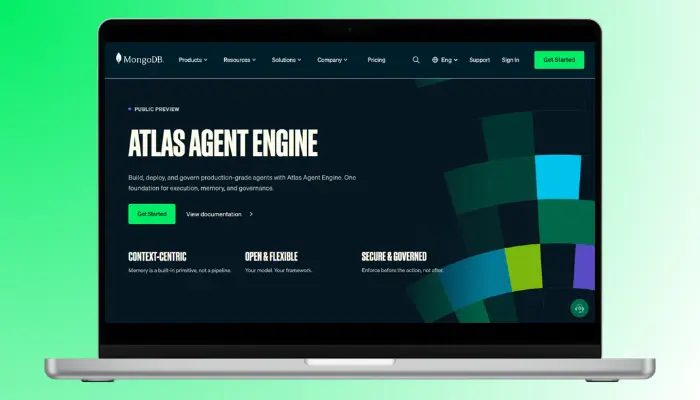
Sydney, Australia – MongoDB has launched Atlas Agent Engine, a platform designed to provide execution, memory, retrieval and governance capabilities for enterprises deploying artificial intelligence (AI) agents in production.
MongoDB said the platform is designed to address challenges associated with moving AI agents from proof-of-concept projects into production environments, including information retrieval, persistent memory, security and governance.
“Investigating unusual activity in our payment network today means our analysts stitching together data from multiple systems by hand, often under time pressure,” said Amar Akshat, SVP of Architecture at Paysafe.
“We’re excited about the potential for an intelligent agent, built on MongoDB’s Atlas Agent Engine, to shrink the time between a problem emerging and our team acting on it, giving our analysts more time to focus on the judgment calls that matter most,” Akshat continued.
Atlas Agent Engine provides a modular architecture, allowing customers to adopt its runtime, memory and governance capabilities independently or together. Retrieval capabilities are powered by Voyage AI, which provides embedding and reranking models.
The company said customers can use existing AI models and frameworks alongside Atlas Agent Engine. Atlas Agent Runtime and Atlas Agent Memory use consumption-based pricing, with usage drawing on customers’ existing Atlas commitments.
“Context is the critical success factor in successfully using agents for application development. Enterprises are currently struggling to assess, integrate and manage information across multiple systems to enable an ontology for autonomous agentic work.” said James Governor, Co-founder of RedMonk.
“MongoDB Atlas Agent Engine is designed to bake governance into agentic app development with a single platform for memory and identity,” Governor continued.
MongoDB said the platform has been developed to work with its existing ecosystem, including AI model providers and system integrators. The company said these partners can provide models, industry expertise and implementation capabilities for enterprise agent deployments.
“Atlas Agent Engine brings the enterprise-ready capabilities, context, and constraints needed to help AI agents deliver real-world impact,” said Ram Ramalingam, Global Lead, SW Engineering & Head of RDE Accenture.
“Combined with Accenture’s governance, architecture, and deep industry expertise, it creates a powerful foundation for accelerating AI transformation and delivering outcomes at scale. Our shared commitment to delivery and customer success makes this partnership particularly strong,” Ramalingam continued.
Australian organisations explore agentic AI applications
Australian organisations are also exploring potential applications for Atlas Agent Engine, including fintech company Lendi Group.
The company is evaluating the platform for marketing production tasks that involve complex, long-running and non-deterministic processes, including managing image layers and compliance requirements within images.
“Designing marketing collateral for our retail locations is a manual process today, and it’s one we think is well suited for agent-assisted support,” said Devesh Maheshwari, CTO of Lendi Group.
“We’re evaluating MongoDB Atlas Agent Engine’s ability to handle the complex, long-running, non-deterministic tasks like managing image layers and in-image compliance, that our current agent platform struggles with. We see real potential to close that gap while bringing far more efficiency to how we produce marketing materials across our retail network,” Maheshwari continued.
Built for enterprise AI agents
MongoDB said Atlas Agent Engine addresses three areas that can complicate enterprise agent deployments: governing agent actions, maintaining persistent memory and avoiding dependence on a single AI model or framework.
“Organisations that want to put agents in production are being forced into a false tradeoff: either adopt one vendor’s runtime and accept being locked into a model and cloud, or piece together a framework and manage governance and memory on their own,” said Pablo Stern-Plaza, Chief Product Officer, AI and Emerging Products at MongoDB.
“With the launch of Atlas Agent Engine, that false tradeoff ends today. Enterprises get the real-time context their agents need, with governance and security built in from the start, and the freedom to run any model, any framework, and on any cloud. We didn’t want to ask customers to predict the future. We wanted to build something that works no matter what they choose,” Stern-Plaza continued.
The platform includes identity, audit, guardrails, and cost controls through a central control plane, according to MongoDB. The company said agent actions can be logged against human or agent identities and governed through policies.
MongoDB also said Atlas Agent Engine incorporates memory and retrieval capabilities to allow agents to retain context between interactions. The system uses Voyage AI embeddings and MongoDB’s native retrieval capabilities to support information access.
The platform is designed to work across different AI models and frameworks and supports open standards including the Model Context Protocol (MCP) and Agent2Agent (A2A) protocol.
MongoDB said Atlas Agent Engine can run across different cloud environments, in self-managed deployments and on local machines, allowing organisations to use the same agent without rebuilding it for different environments.
The company also announced that it is joining the Linux Foundation’s Open Secure AI Alliance and Agentic AI Foundation. MongoDB said the move is intended to support the development of open software and standards for secure and interoperable AI agents.
Atlas Agent Engine forms part of a wider set of MongoDB announcements alongside MongoDB 9.0 and Atlas Infinite.
MongoDB said MongoDB 9.0 provides the underlying database foundation, Atlas Infinite is designed to provide additional scalability, and Atlas Agent Engine adds capabilities for deploying AI agents on top of real-time data. The company is also positioning these offerings alongside Voyage AI’s embedding and retrieval models as part of its broader data platform for AI applications.