
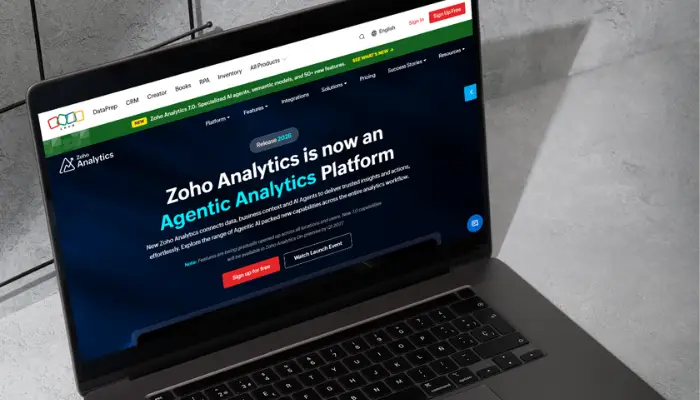
Singapore – Zoho Corporation has expanded its analytics platform with new agentic AI capabilities, introducing semantic and ontology layers designed to help AI agents interpret business data, generate insights and support operational workflows.
Announced on 10 November 2026, the update evolves Zoho Analytics into an agentic analytics platform that brings together data, business context, analytics and AI agents. The company said the changes are intended to help organisations move beyond data analysis towards making decisions and taking action based on business insights.
The platform’s semantic layer acts as a business glossary, defining key terms, metrics and their meanings to help AI interpret information according to an organisation’s operations. Its ontology layer maps business entities and their relationships, providing additional context for generating relevant insights and recommendations.
“We are at the beginning of the next leap forward in data analytics, where a strong data foundation is the starting point for all agentic activity in business operations,” says Gibu Mathew, Managing Director of Zoho APAC.
“Agents, however, cannot function only with data, but require a robust intelligence layer. Today’s updates to Zoho Analytics provide that and more: one open and extensible trusted intelligence layer that gives every AI tool in your business the context, metrics, and governance to deliver answers users can rely on,” Mathew continued.
A central part of the update is Ask Zia, Zoho’s conversational business intelligence agent, which now uses a multi-agent architecture. It comprises six specialised agents covering data analysis, modelling, visualisation, preparation, coding and SQL generation.
A central agent coordinates these specialised functions while maintaining the same semantic layer, ontology and conversation context. This allows users to move between tasks, such as analysing information and creating data pipelines, without losing the context of their interactions.
Organisations can also develop custom agents grounded in their own data, semantic models and knowledge bases. These agents can connect to external tools and systems through the Model Context Protocol (MCP), web search and other integrations. They can also trigger workflows and actions directly through the platform.
Zoho Analytics is extending its intelligence capabilities beyond its own interface through MCP support, enabling developers to build agentic applications using the platform’s data analysis, preparation and visualisation tools. The company has also introduced a command-line interface and a plug-in that allows users to work with Zoho Analytics through Claude.
The platform supports embedded AI agents in external applications, portals and products through white-label capabilities, with permissions and governance controls retained across deployments.
The update also introduces administrative controls covering data access, agent activity and AI usage. Its data catalogue provides visibility into data assets, metrics, models and lineage, while AI observability features allow administrators to monitor which agents have run, who used them, what information they accessed and how they responded to queries.
Administrators can also track AI usage and costs across teams and manage Ask Zia settings. A sandbox environment enables teams to develop and test analytics assets and agents before deploying them into production, with options to roll back to earlier versions.
Alongside the agentic capabilities, Zoho Analytics is adding more than 30 data connectors to its existing collection of over 500. New integrations include Zoho ERP, Zoho Spend, Zoho FSM, Zoho Shifts and Zoho Voice, as well as third-party platforms such as SAP, PayPal, Adobe Commerce, Twilio, Notion, Intercom, Supabase, Amazon DocumentDB and AlloyDB.
The company said its semantic and ontology layers are built natively into Zoho Analytics, rather than requiring a separate data platform or cloud data warehouse. Organisations can create multiple semantic models for different business functions, while Apache Ossie compatibility allows business definitions to be transferred beyond the platform.
Other additions include more than 10 new visualisations, custom visuals, pixel-perfect reports, predictive analytics tools and a data science studio with Jupyter notebooks and PMML import support. Ask Zia is also available on mobile with an updated interface.