
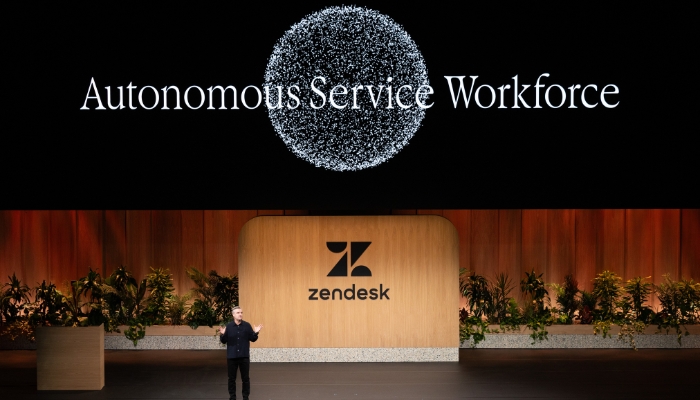
Singapore – Zendesk has announced a new strategy centred on what it calls the Autonomous Service Workforce, introducing a suite of AI-powered capabilities designed to support customer and employee service operations. The announcement was made during the company’s annual Relate conference.
The initiative is built around the Zendesk Resolution Platform, which combines data, workflows, knowledge, intelligence, and governance into a unified system. According to Zendesk, the platform has been trained on approximately 20 billion ticket interactions and uses its Resolution Learning Loop to continuously improve responses and identify knowledge gaps through ongoing interactions.
Tom Eggemeier, CEO of Zendesk, said the company sees autonomous AI agents becoming a central part of future service operations.
“The era of the chatbot – the era of frustration and deflection – is over. We are entering the age of the Autonomous Service Workforce,” said Tom. “We believe every business will soon run on specialised AI agents that work alongside human experts as one unified team. These agents will be more than just code; they will be team members, held to the same high standards of accountability as any human.”
He added, “Our vision is to put the power to build this workforce into the hands of every enterprise, on one elegant platform. Whether those agents are crafted by Zendesk, by our partners, or by your own teams, they will all speak with one voice. We are providing a future where AI is the foundation, and human experts are the architects.”
The company said the platform is intended to move beyond traditional chatbot deployments by enabling AI agents to work across multiple channels and service functions while focusing on issue resolution rather than ticket deflection.
According to Zendesk, the platform is designed to address service challenges across the Asia-Pacific region, where businesses often operate across multiple languages, markets, and customer journeys.
Bikram Mazumdar, Vice President for Asia at Zendesk, commented on the regional implications of the technology.
“Across Asia, service is rarely a single-market problem. It is a multilingual, multi-modal and multi-journey challenge that looks very different in Singapore, the Philippines, Indonesia, Hong Kong, South Korea and beyond. As AI resets expectations for what good service should look like, the old model of scaling support linearly simply cannot keep up. The Zendesk Resolution Platform powers an autonomous service workforce that enables Asian enterprises to move beyond the trade-off between efficiency and service quality. It brings the precision, context continuity, and governance needed to deliver high-touch support at the pace the region now demands.”
Among the new capabilities introduced was Agent Builder, a no-code tool that allows organisations to create, test, deploy, and optimise AI agents tailored to specific business processes, policies, and workflows.
Zendesk also expanded its AI agent offerings to operate across messaging, email, voice, and external AI platforms such as ChatGPT and Gemini. The company said these agents can maintain context across interactions and environments. This functionality has been enhanced in part through Zendesk’s acquisition of Forethought.
The company further announced expanded support for Voice AI Agents, including multilingual capabilities across more than 60 languages and the ability to switch languages during conversations while maintaining context. These capabilities support Zendesk’s contact centre offering powered by Amazon Connect.
For employee service use cases, Zendesk introduced autonomous AI agents designed for internal support environments. Powered by the company’s acquisition of Unleash, the agents can operate within platforms such as Slack and Microsoft Teams while enforcing access permissions across enterprise systems.
Zendesk also announced updates to its Copilot portfolio, including Agent Copilot, Admin Copilot, Knowledge Copilot, and Analyst Copilot. The tools are designed to assist service agents, administrators, knowledge management teams, and analysts through automation, recommendations, content management, and analytics.
Additional announcements included Quality Score, a feature that automatically evaluates service quality across human and AI interactions, and Context Graph, an operational memory layer designed to improve analytics and recommendations by capturing historical analyses and performance data.
The company also introduced Action Flows for AI Agents, enabling organisations to create workflows directly within Action Builder. Zendesk said the feature is intended to help AI agents execute actions across connected systems while maintaining governance controls. The release is accompanied by 40 prebuilt workflow connectors, with more than 100 additional integrations planned by year-end.
Zendesk further announced support for Model Context Protocol (MCP), including client and server capabilities that allow AI agents and copilots to connect with external systems and data sources in a governed manner.
Alongside the technology announcements, Zendesk said it is expanding its outcome-based pricing model. Under the approach, customers are charged only for interactions that are verified as fully resolved by AI agents and independently confirmed through a separate AI evaluation model, while spam and routine exchanges are excluded.
Commenting on the broader direction of AI-powered service, Daniel Newman, CEO, Futurum Research, said:
“What’s compelling about Zendesk’s direction is that it recognises a core truth about service: automation on its own is not enough. To improve the experience meaningfully, AI has to be part of a broader system that can connect context, take action, and evolve with the needs of the business. That’s the kind of approach that can help organisations build a more scalable and responsive support experience over time.”