
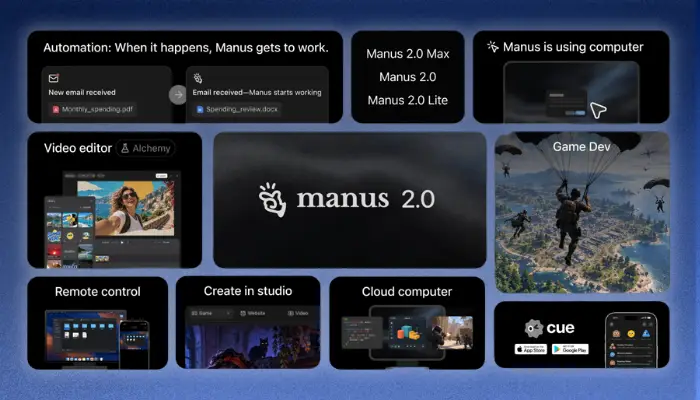
Singapore – Manus has released Manus 2.0, an overhaul that introduces a new agent architecture, a desktop workspace for video and game creation, and a standalone app for personal AI agents. The company, which operates under Meta, announced the update in a blog post.
The company said the release goes beyond a routine upgrade. Manus 2.0 is not a version update. It’s a new architecture, new products, and new capabilities built around a fundamental question: what should the next generation of Manus look like?
At the core of the update is Cascade, which Manus describes as the latest iteration of its in-house agent harness. According to the company, it keeps a project light from the start and brings in specialised capabilities only when the work needs them.
Manus also reported efficiency gains. In one tested configuration, it said, Cascade used 23.2% fewer tokens, finished tasks in 28.2% less time and cost 32% less to run than the previous system.
Alongside the new harness, Manus introduced Cloud Computer, a paid, dedicated environment for projects that need a permanent home. The company said that some projects outgrow one machine, and cited a multiplayer game server or an around-the-clock automation as examples.
Manus also extended its Scheduled Tasks feature into Automations, so work can begin when an event occurs in a connected service rather than only at a set time. Triggers include a new email, a change in ad performance, a calendar event, a Slack message or a Notion update.
Users configure a workflow through a single prompt. “Just tell Manus in a single prompt what to watch and what to do next, and it sets up and runs the workflow,” the company said.
The desktop app has been renamed Manus Studio, which Manus describes as “a shared workspace for people and AI.” Studio loads only the tools a project requires, which the company says keeps Manus focused on the task at hand.
The release upgrades Studio for documents, spreadsheets, PDFs, slides, websites and code. It also adds two new professional environments, Video Editor and Game Dev.
Video Editor addresses a limitation of earlier versions, where changing a generated video meant writing a new prompt and regenerating the whole clip. Now, the company said, “Manus gives you the timeline instead.”
Clips, images, text, motion graphics and audio appear as separate pieces that users can swap, move or replace with their own footage. Manus can then take another pass that works from those edits.
Manus said the tool targets short product ads of 30 to 60 seconds, AI-generated user content, data motion graphics, tutorials, vlogs, and motion-led videos.
Video Editor also includes Alchemy mode, in which Manus handles creative direction using video and code generation together. The company claimed the mode brings better ideas, tighter control of visual detail, more polished motion and improved pacing, and said users can still fine-tune results on the timeline.
Game Dev, meanwhile, combines video, image and coding models. Manus said it is designed so that users can build the game they envisioned, stating that Game Dev is for making the version you actually had in mind.
An Edit panel lets users watch the game run, manage assets, edit code and change movement, art and scenes by hand. Users can start from a playable template and publish the finished game as a website playable from a link.
Multiplayer support is a central feature. The company said that this multiplayer is where most projects like this stall, because it requires an always-on server, and Game Dev instead uses a Cloud Computer that users configure in a few clicks.
Manus said this works for racing, head-to-head, competitive and 3D games.
Separately, Manus introduced Remote Control and Computer Use, which let users direct their computer from a phone by voice. In a connected and authorised session, Manus works in its own visible workspace using the files, browser and apps the user has approved.
The company stressed user oversight. It said Manus can test an app or keep working while a user is away, and “you stay in control of what it does.”
The third element of the release is Cue, a standalone app for personal agents on phone and desktop, built on the same infrastructure as Manus. Manus said the concept is simple; To give it a cue, and it gets to work.
In Cue, each agent has its own email, phone number, wallet, and computer. Agents can send messages, pay within a user-set budget, take calls and leave a summary in the app.
Users can also place several agents in a group chat with a shared goal, so that they hand work to one another. “You set the direction and make the final call,” Manus said.
Cue also connects to everyday services. At a restaurant, for example, a user can scan a QR code and the agent can order or hold a place in line.
Manus closed the announcement by framing the release around its founding aim, which is to help people turn ideas into something real, and Manus 2.0 keeps that promise.