
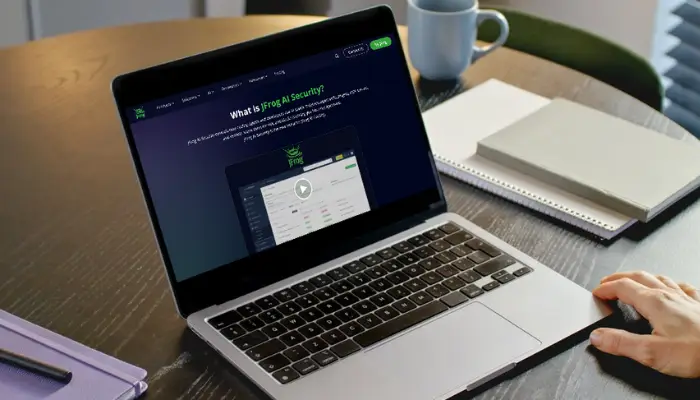
United States – JFrog has expanded its AI security capabilities with tools designed to detect, scan and enforce policies for AI agents, models, plugins and other assets used throughout the software development lifecycle.
The updates to JFrog AI Security include Local Shadow AI Detection, which identifies AI assets running on developers’ workstations, and AI Asset Scanning with Bring Your Own LLM Key (BYOK), which allows customers to scan AI assets using their own large language model (LLM) infrastructure.
The company said the additions aim to give security and development teams greater visibility into AI assets that may be introduced outside established software security controls, while helping organisations assess potential risks before deployment.
“Developers are already running AI agents organisations can’t see. JFrog AI Security brings them under control. Until now, the conversation around AI agents has focused on what they can build vs. what they can break or who answers for it when that happens,” said Shlomi Ben Haim, Co-Founder and CEO of JFrog.
“The question is no longer whether agents will touch your supply chain – it’s whether you can prove what they touched. Our customers live in a zero-trust world and can’t trust AI agents or developers using AI blindly. JFrog brings detection, scanning, and policy enforcement for the AI-powered software supply chain into one solution,” Haim continued.
Detecting AI assets on developer workstations
JFrog’s Local Shadow AI Detection extends visibility beyond software pipelines and registries to developers’ machines, where AI skills, plugins, Model Context Protocol (MCP) servers and other agent-related assets may be installed through repositories, messaging platforms, marketplaces or downloaded files.
The tool is designed to detect assets as they are introduced, using the JFrog Agent Plugin deployed on developer workstations through mobile device management systems or agent harness settings. It performs scanning locally, sending only metadata and risk assessments to the JFrog Platform.
Detected assets are also compared against source information in the platform to help security teams determine whether they have been approved for use.
JFrog said the approach is intended to help organisations identify which AI assets are in use, who introduced them and whether they have undergone security review. This is particularly relevant because agent-related tools can operate with the permissions and credentials available to their users.
The company’s wider AI security offering also includes JFrog Agent Guard, which enforces policies when an AI agent attempts to access assets. Together, the capabilities are intended to provide a central view of AI assets and support security controls across development and production environments.
AI asset scanning using customers’ own models
The new BYOK option allows customers to use their own private LLM accounts to scan AI models, agent skills, coding agent plugins and APM packages.
Under this approach, prompts and skills are sent directly from the JFrog Platform to the customer’s model endpoint rather than through a JFrog-hosted gateway. Customers can also use existing LLM provider agreements and be billed through their chosen provider.
JFrog said BYOK is the only way for customers using its self-hosted platform to run AI Asset Scanning.
The scanning capability is designed to assess the intent of AI-related assets, including instruction-based components that may not be detected by conventional application security tools focused on vulnerabilities in code.
“Security teams need visibility that starts at the developer’s machine – before an asset ever reaches a coding agent or is shared through Artifactory. Regulated customers need scanning that points at their own models,” said Yuval Fernbach, Vice President & CTO at JFrog AI Security.
“Local Shadow AI Detection and AI Asset Scanner address both needs in a single solution: JFrog AI Security,” Fernbach continued.
JFrog cited figures from its software supply chain security research that identified 969 AI agent skills carrying high-impact malicious payloads and 495 malicious AI models on Hugging Face. The company said these findings highlight the need to assess agent skills, plugins and other AI components alongside traditional software dependencies.
JFrog AI Security, including Local Shadow AI Detection and AI Asset Scanning, is available to JFrog Unified Security and Ultimate Security customers. The initial BYOK release supports Anthropic’s Opus 4.8, OpenAI’s GPT 5.6 Sol and Google’s Gemini 3.1 Pro.