
Manila, Philippines – Retailers have never had more data about what shoppers want. But the more they know, the easier it is to cross a line customers can feel immediately, the one between a store that helps and a store that stalks.
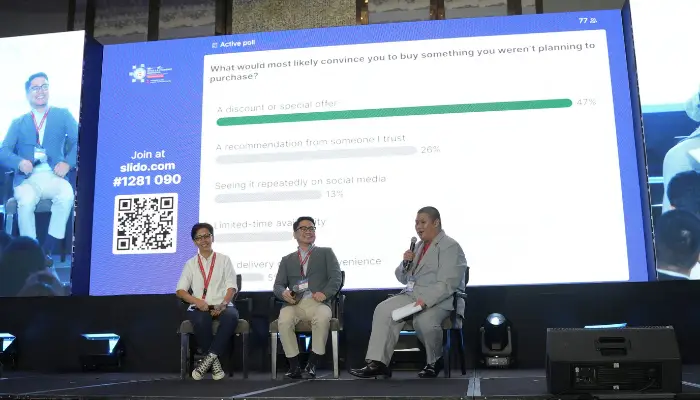
That was the focus in the panel discussion, The Power of Predictive Data: Anticipating Shopper Needs for Smarter Retail, featuring Jason Ocampo, AVP for Technology and Data Protection Officer at National Bookstore, and Beverly Maddul, Head of Performance Marketing and Customer Lifecycle Management at Concepcion Industrial Corporation, during the Retail & E-Commerce Innovation Marketing & Tech Summit Philippines 2026, held on September 10 at Shangri-La The Fort, Manila.
Aimed at retail and e-commerce teams eager to put predictive analytics to work, the discussion made the case that the technology’s real challenge isn’t collecting more data. It’s deciding what data deserves to be used, and acting on it fast enough to matter. Predictive analytics simply means using past and live information, like sales, store traffic, and website visits, to make smart guesses about what customers will want next.
The panel’s through-line wasn’t really about prediction. It was about restraint, timing, and speed, and about who is still accountable when the algorithm gets it wrong.
Where “cool” ends and “creepy” begins
Ask a data protection officer where personalisation goes wrong, and Jason has a short answer. “This is really an understanding of what’s cool versus what’s creepy,” he said.
Collecting more customer data doesn’t make a promo better, Jason said. For National Bookstore, whose shoppers are mostly kids and teens, every name, birthday, and address also means a parent’s consent. “Do we really need to get the names and the birthdays and addresses of these people in order for us to come up with a very effective promo?” he asked. “It’s actually not.”
The alternative is anonymisation, which strips out details that point to a specific person. The store studies patterns, such as what was bought and why shoppers came in, without ever knowing who the shopper is.
The second rule is about guessing. A purchase, Jason argued, should never become an assumption about someone’s finances or health. “Our algorithm should focus on the products,” he said. Shoppers who buy a book often buy a plastic cover for it, so that is the pattern the system should learn. “We can be a helpful retailer rather than an intrusive spy to our customers,” Jason added.
Beverly tackled the same problem from the marketing side with a checklist she calls PRF:
- Permission: the customer agreed to hear from you.
- Relevance: the message fits what they actually need.
- Frequency: the timing respects how people really buy.

Beverly Maddul, Head of Performance Marketing and Customer Lifecycle Management at Concepcion Industrial Corporation
Her example comes from appliances. Nobody buys an aircon twice in a month, so a discount email for the same unit a few weeks later misses the point. Better, she said, is a check-in: how is your aircon, here are the service hotlines, here are maintenance tips, and here is a reminder about your warranty. “It has a story, it is not forced,” she said.
For retailers, the lesson is blunt. Personalisation that ignores permission and timing isn’t personal at all. It’s just noise with a customer’s name on it.
Reading shoppers’ intent before they buy
Once a store knows what data it can use, the next question is what that data is telling it.
Beverly said retailers have three sources of information to guide a campaign, and each one looks at a different point in time:
- Market research looks ahead. It guides the big plan and the product itself.
- Historical data looks back. It guides the next month, quarter, or year.
- Intent signals look at right now. They show what shoppers are doing at this moment, like viewing a product or adding it to their cart.
The third one is the most urgent. “When it happens, you also need to take action right away,” Beverly said.
Her glass air fryer campaign shows all three in order. Market research said shoppers wanted one, so the product was featured. Then history backed it up: on the 6-6 sale, 10,000 units sold within the first hour, so the team pushed harder for 9-9.
But on 9-9, the live numbers told a different story. Product views and add-to-carts were high, but an hour after the 8 p.m. launch, few shoppers were actually buying. “The conversion is not moving,” she said. Conversion is the share of visitors who go from browsing to buying. “So you need to do something,” she added.
The team read the signals. The carts showed the product page was doing its job, because shoppers clearly wanted the air fryer. The problem was the price: the discount was probably weaker than the one on 6-6. Their fix was a limited-time bundle: buy within the first two hours and get a free container.
The lesson is simple. Research and history told the team what to expect, but only the live signals showed what was actually happening, in time to change the outcome that same night.
Intent signals also show that shoppers aren’t all alike. Fifteen people looking at a dehumidifier might include one who needs a one-liter model and another who needs a thirty-liter one. Knowing the difference tells a team, in Beverly’s words, “who they are, how to communicate, and when to engage.”
Why real-time data beats the forecast
Reading one shopper’s signals is one thing. Keeping up with them across dozens of stores is another. Even a well-behaved model can be caught off guard, and Jason used the weather forecast as a comparison. “The forecast is like when you check the weather on your app, but the real-time is when you look at the window and, oh, there’s rain.”

Jason Ocampo, AVP for Technology and Data Protection Officer at National Bookstore
In his view, predictive tools set the baseline. They answer the what, when, and where from historical data. The why only shows up in what is happening right now, like an influencer’s post sending shoppers rushing to a single store for one product.
The fix is feeding live point-of-sale data, the running record of what’s being bought at the register, into the prediction system. That lets the system flag a sudden rush and trigger a same-day stock transfer. If a viral item is selling out at the Mall of Asia branch, nearby stores in Megamall or Mandaluyong can be alerted to send their stock over.
The idea also explains how National Bookstore thinks about its shelves. Copying the same stock plan into every branch “doesn’t work anymore,” Jason said. Small NBS Everyday stores in bus terminals and provincial towns focus on school basics, while larger super branches in busy cities carry more variety. Concept stores like Art Bar and Kids Inc. go where their audiences are.
“Predictive analytics gets you in the game,” he said, “but the real-time agility at the end of the day lets you win the day.”
The panel wasn’t really about better algorithms. It was about the judgment wrapped around them. Beverly and Jason came at predictive retail from different angles, one from marketing and one from data protection, but both landed in the same place: data is only as useful as the care taken in using it.
Collect only what you need, act on early signals while there’s still time to change the outcome, and keep checking the forecast against what’s happening live. The technology does the heavy lifting in the background, but people still decide what to do with what it finds. It’s important to note that predictive tools will sometimes miss, whether on a viral spike, a flat sale, or a message that lands at the wrong time.
What separates the stores that recover from the ones that don’t is what sits around the tool: privacy that sets the limits, live signals that correct the forecast, and a person who knows how to respond. Get that right, and shoppers feel the difference. The store feels helpful, not watchful, and that is what keeps customers coming back.