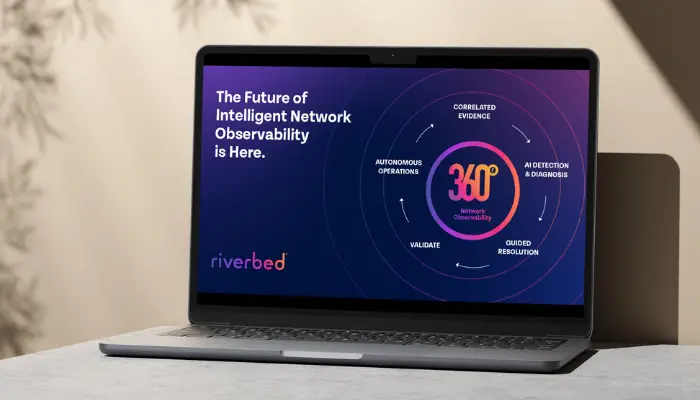


Sydney, Australia – Nine in 10 organisations plan to use agentic AI to support autonomous IT operations, but most remain reluctant to let AI make operational decisions without human approval, according to new research from Riverbed.
The research found that 76% of organisations consider agentic AI critical to their future IT strategy, while 91% said their AI investments have met or exceeded expectations. At the same time, 77% remain hesitant to allow AI to make operational decisions without human approval.
The findings suggest that organisations are moving beyond AI experimentation towards integrating the technology into their IT operating models. While 90% expect to achieve human-supervised or highly autonomous IT operations within the next two years, only 19% of IT operations are currently automated.
The research, based on responses from 1,200 business decision-makers, IT leaders and technical specialists across seven countries, also highlights a gap between AI ambitions and operational readiness.
Only 41% of organisations said their environments are fully prepared for AI, while just 8% reported enterprise-wide AI-enabled operations and 9% said their AI initiatives were fully deployed across their organisations.
“The journey to autonomous IT is well underway. Organisations increasingly see AI as the path to more resilient, efficient and proactive IT, but our research shows significant gaps between ambition and readiness,” said Jim Gargan, Chief Marketing Officer at Riverbed.
“While 96% say multi-domain visibility is important for AI-driven IT operations, only 17% have fully unified visibility across networks, applications, endpoints and cloud. At the same time, 92% believe AI observability and governance will become a critical new IT domain, yet 77% remain hesitant to allow AI to make operational decisions without human approval.
The next phase of AI is not simply more automation, but AI that enterprises can understand, trust and govern. Riverbed is helping customers close these gaps with unified observability, trusted data, AI governance and intelligent automation, accelerating toward zero-disruption autonomous IT operations,” Gargan continued.
Visibility and data quality remain barriers
The research identified data quality, multi-domain visibility and tool consolidation as key requirements for organisations seeking to scale AI-driven IT operations.
Although 96% of respondents said multi-domain visibility is critical, only 17% reported fully unified visibility across networks, applications and endpoints. Data quality also remains a concern, with 23% rating their data granularity as excellent and 21% giving the same assessment for data quality.
Tool consolidation was identified as another factor in simplifying IT operations. Some 91% of respondents agreed that consolidating tools can reduce friction, while 90% said a unified platform makes it easier to identify and resolve problems.
AI expected to reshape the service desk
AI-driven operational intelligence is also expected to change the role of IT service desks and digital employee experience functions.
Some 93% of respondents expect AI-powered operational intelligence to transform frontline IT and service desk capabilities within two years. By 2028, 27% expect autonomous operations to significantly reduce service desk activity, while 22% believe agentic AI will allow teams to focus on more complex issues.
A further 35% expect service desk roles to shift from reactive support towards proactive prevention. However, only 34% currently consider their IT operations teams extremely effective at using AI to identify and resolve issues before employees experience a disruption.
Security and trust remain central concerns
Security and compliance concerns were identified as the leading obstacle to wider use of agentic AI, cited by 55% of respondents. The risk of operational disruption followed at 45%, while 39% pointed to a lack of trust in AI decisions.
Confidence in AI governance also remains limited. Only 42% of respondents said they were highly confident in their organisation’s AI governance, falling to 36% among technical specialists.
While 92% believe AI observability and governance will become a critical IT domain, only 24% said they extensively trust AI recommendations with limited human review.
The findings indicate that organisations are moving towards more autonomous IT operations but remain focused on establishing the visibility, data quality, governance and human oversight needed to deploy AI at scale.