
Manila, Philippines – As brands race to bolt AI capabilities onto their marketing stacks, a more disruptive shift is quietly taking shape at the other end of the transaction: customers may soon delegate their shopping, bookings, and brand interactions to AI agents acting entirely on their behalf.
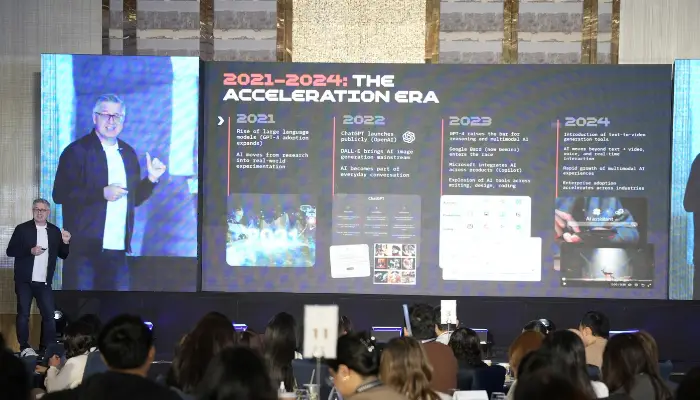
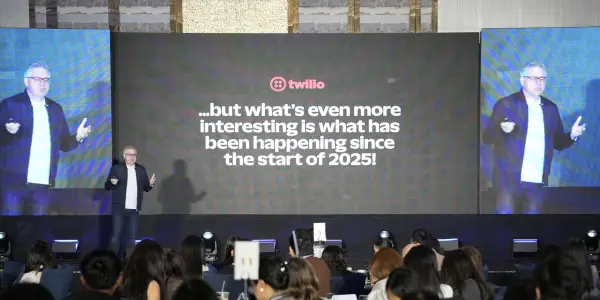
This was the key point of discussion for the keynote presentation, delivered by Nicholas Kontopoulos, Vice President of Marketing, Asia Pacific & Japan at Twilio, during the recently concluded Retail & E-Commerce Innovation Marketing & Tech Summit Philippines 2026, held on September 10 at Shangri-La The Fort, Manila.
Aimed at retail and e-commerce leaders still treating AI primarily as a productivity tool, the keynote made the case that the technology’s next phase isn’t about generating content faster — it’s about AI agents transacting directly with brands on a customer’s behalf.
Drawing on a transformation journey inside Twilio and a live case study from customer GenSpark, the presentation argued that the real risk for brands isn’t failing to adopt AI. It’s building for it backwards — bolting on tools before the infrastructure, processes, and people needed to serve a machine-mediated customer are actually in place.
The presentation’s through-line wasn’t really about the agents. It was about what brands need to rebuild before one shows up at their digital door — and what, even then, no agent will be able to do for them.
When AI agents become the customer
To show what this looks like in practice, Nicholas played a short demo video from GenSpark, a company that builds AI agents and is also a Twilio customer. In the video, an AI assistant books a restaurant table in Japan for its human “boss” — communicating in Japanese, mentioning a peanut allergy, and requesting a nice dessert. The person it was booking for didn’t speak Japanese and didn’t need to; the AI handled everything.
“This is a new reality of what’s coming now,” Nicholas told the audience. “If you’re marketers or customer experience folks in the audience, we’re gonna have AI agents working on behalf of our customers, you know, engaging with our brand — so we need to start thinking about how, what that means for us.”
This pattern is known as “agentic commerce” — software that shops, books, and transacts for a person, instead of the person doing it themselves. Most companies build their websites, apps, and customer service for humans to click through. But if AI agents start doing the clicking instead, brands need systems a machine can understand and interact with too, not just people.
Nicholas connected this to a bigger pattern in tech history: big shifts rarely come from one invention alone — they come from several technologies arriving at once. He pointed to the iPhone in 2007 as an example.
He also recalled the iPhone’s 2007 launch as a turning point in how brands engaged with customers — not because of the device itself, but because Apple timed its release alongside the maturing of Wi-Fi, faster mobile networks, and thoughtful design, all converging at once.
He said Amazon and Alibaba did something similar for online shopping — they didn’t just launch a website, they reimagined the way e-commerce and retail — could actually be transacted. AI agents, in his view, are simply the next version of that same kind of shift.
Readiness starts with people, not platforms
If the AI-agent video was the exciting part, the rest of the talk was a warning–don’t just go buy a new AI tool and think the problem is solved.
“There’s no one technology, no one business methodology that’s going to solve your business problems,” Nicholas said. “You’re going to have to think and partner with lots of different folks internally and externally to drive change in your organisations, because organisations are complex. They’re not linear.”
He described his own approach to AI change at Twilio using a simple order—people first, then process, then technology — never the other way around. “It’s not just about technology,” he said. “I’m going to shift gears and focus on the people and process side, because the reality is everyone in this auditorium today comes from an organisation that has its own unique DNA.”
The payoff took time. His own personal use of AI, which he started in 2022, gave him what he estimated as about a 30 to 40 percent increase in terms of my ability to unlock new capacity. When he applied the same approach across his whole team — reorganising how they worked, deciding what tasks to automate and what to leave alone, and building small cross-team groups to test new ideas — the results scaled up too.
“It really enabled us to drive, I would say, as a team, our ability is, you know, 2x, 3x in terms of its ability to… hit the goals we’re trying to achieve on a year-on-year basis.” That, he said, took an 18-month to 24-month journey of testing, learning, and adapting — not an overnight fix.
For brands eyeing agentic commerce, the lesson is blunt–an AI agent showing up to book, buy, or interact with a business is a test of whether that business’s systems and teams are actually ready, not just whether it’s bought the right software.
What stays human: the art in the science
If AI agents can handle bookings and transactions, what’s left for people to actually do?
Nicholas answered this by flipping a familiar marketing phrase. Instead of “the art and science” of marketing, he said, think of it as “science and art” — in that order. “In the marketing world, we always talked about the art and science. I’ve inverted that. I talked to my team about using AI from a science and art perspective.”
In his explanation, the AI — the “science” — handles the heavy lifting, digging through data, spotting patterns, doing the repetitive analysis work. But the “art” — creativity, taste, and the judgment calls that make a brand feel like that brand — still needs a human.
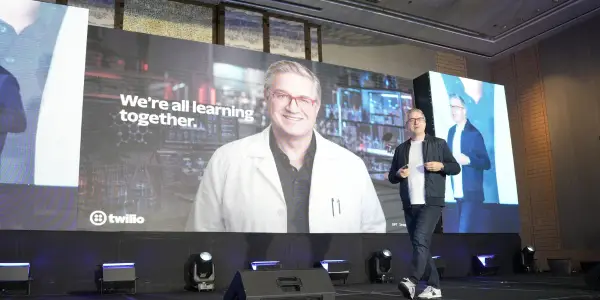
“Use the Large Language Models (LLMs) as a way to unlock new insights that we couldn’t get to before,” he said, “but still bring the human taste, the human creativity into then ideating and thinking about how you take that insight and actually deploy a new campaign or whatever it might be in a way that differentiates yourself from your competitors.”
He connected this directly to a common worry people have about AI taking jobs. “We’ve moved away from the era where machines did all the work to an era where now humans will look to do or complement the technologies,” he said.
“People will do the jobs that machines can’t do.” In his view, Nicholas further added. AI doesn’t replace people — it frees them up from repetitive tasks so they can be redeployed in new and exciting ways.
This matters for competition, too. As more of the transaction work — the booking, the checkout, the delivery — gets handled by AI agents, that part becomes easy for any company to copy. What’s harder to copy is the creative, human part: the ideas and taste that make a brand memorable instead of forgettable.
Nicholas also warned that customers are changing their expectations faster than most companies can keep up — something he called “Digital Darwinism,” a term he credited to author Brian Solis.
“There’s a term called digital Darwinism… the idea behind that is we as consumers are adapting faster than the brands trying to service [them].” An AI agent doing your shopping for you, he suggested, is just the newest, sharpest example of that gap.
This talk wasn’t really about a robot booking a dinner reservation — it was about getting the order right. AI agents are coming, so readiness has to come first, and what makes a brand special has to survive the change.
“AI is only as good as the data we collect,” Nicholas said, and his closing advice was less about new tools than mindset: “Don’t be afraid to experiment. If you haven’t started playing with these tools, stop playing, start experimenting.”
The next phase of AI is not about generating content faster, but about how brands retain its human essence. In the current shift toward an agentic era, AI agents are transacting directly with brands on customers’ behalf and the reality is that most companies aren’t structurally ready for this shift.
It’s important to note that every new technology integrated into a system will be messy at first. But when that integration starts with rebuilding people and process — not just adopting the tool — readiness follows, and so does the ability to protect what no agent can replicate human judgment, taste, and creativity.