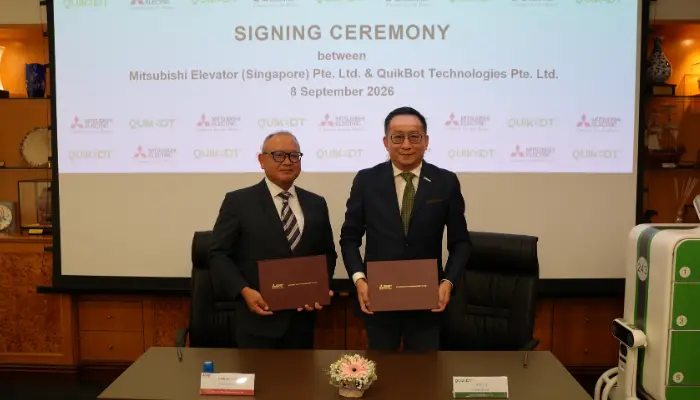

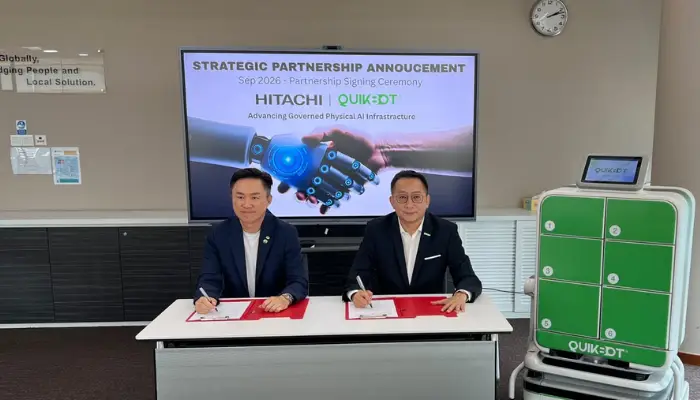
Singapore – Hitachi High-Tech (Singapore) Pte. Ltd. and QuikBot Technologies Pte. Ltd. have signed a strategic collaboration agreement in Singapore to develop trust infrastructure for Physical AI across buildings and enterprise environments in Southeast Asia, the companies announced on 14 September 2026.
The agreement brings together Hitachi High-Tech (Singapore)’s customer engagement network, industry knowledge and access to Hitachi’s operational technology expertise with QuikBot’s QuikSync platform.
According to the companies, most robots today operate as standalone systems that cannot independently access elevators, doors and other building infrastructure.
As Physical AI expands across hospitals, factories, commercial buildings and logistics facilities, the companies say autonomous systems will need to move safely throughout these environments to deliver complete, end-to-end services.
As an initial step, the two companies will explore and validate the integration of QuikSync with Hitachi elevators and building systems. The companies say this integration is intended to let autonomous systems request access and travel between floors and buildings safely and securely.
QuikSync is described by QuikBot as trust infrastructure for Physical AI, enabling autonomous systems — including QuikBot’s own autonomous final-mile delivery robots — to identify themselves, authenticate, obtain permissions and interact with physical infrastructure under defined safety and operational policies.
Through what Hitachi calls its “True One Hitachi” approach, Hitachi High-Tech (Singapore) will coordinate cross-functional expertise from across the Hitachi Group to explore connections between autonomous systems, physical infrastructure and operational systems.
The companies say this is intended to create safer, more secure and better-coordinated autonomous experiences across connected environments, while contributing to a sustainable society.
Together, the two companies aim to enable what they describe as Physical AI Ready Buildings, where autonomous systems can move beyond isolated operating areas and function safely across connected physical environments.
“Healthcare, semiconductor and manufacturing are the most demanding environments on earth. Nothing moves inside a hospital ward or a cleanroom without permission, identity and accountability, and that is exactly what QuikSync provides,” said Alan Ng, Founder and CEO of QuikBot Technologies.
“Hitachi High-Tech (Singapore) has spent decades earning the trust of these customers, and as our Strategic Founding Infrastructure Partner they will bring Physical AI to the buildings where trust matters most. When robots can operate safely there, they can operate safely anywhere, working alongside human teams, never in place of them,” Ng added.
Christopher Han, Director of Hitachi High-Tech (Singapore), said the company, as part of Hitachi’s Connective Industry sector, aims to take a front-line role in connecting customer needs with operational technology, automation, and data to advance Physical AI.
“Drawing on expertise of QuikBot and together with relevant Hitachi entities in physical systems and building operations, the collaboration seeks to transform operational data into actionable intelligence that enables safer, smarter, and more coordinated autonomous operations,” Han said.
“Through this collaboration, the companies can drive new business opportunities in smart buildings, healthcare, manufacturing, and the semiconductor industry within the SEAI region, while strengthening the ‘True One Hitachi’ value proposition across the Group. This initiative connects operational expertise, digital capabilities, and ecosystem innovation to create new value for customers and society,” Han concluded.
Elevators are central to the collaboration’s early scope, as the companies describe them as essential to autonomous operations within multi-storey buildings. Integrating QuikSync with Hitachi elevators is intended to let authorised autonomous systems request access and travel between floors under defined safety, permission and operational requirements.
This, the companies say, would allow autonomous systems to operate across an entire building rather than remaining confined to a single floor or relying on people to operate elevators on their behalf.
Beyond elevators, the scope is intended to extend to other physical infrastructure and building systems, potentially including doors, access gates, loading docks, parcel rooms, facility management systems, security systems, smart parking and digital twins, according to the companies.
These capabilities, the companies say, could support autonomous operations across commercial buildings, hospitals and healthcare campuses, semiconductor factories, manufacturing facilities, logistics centres, hotels and mixed-use developments.
The collaboration will be guided by shared principles that the companies list as safety first, open interoperability, customer value, mutual benefit, human-centric AI, security by design and responsible innovation.
QuikBot describes QuikSync as a common trust and permission layer between autonomous systems and physical infrastructure, under which every connected autonomous system can be identified and authenticated, while its interactions are governed by defined permissions, safety requirements and escalation procedures.
The companies say this is intended to let building and system owners retain authority over how their infrastructure is accessed and used, while supporting the safe deployment of autonomous services that augment rather than replace the people who operate and occupy these environments.
Under the agreement, Hitachi High-Tech (Singapore) will act as QuikBot’s Strategic Founding Infrastructure Partner for the Trust Infrastructure for Physical AI, a role the companies say recognises Hitachi High-Tech (Singapore)’s early commitment to advancing the responsible adoption of Physical AI across Southeast Asia.
Looking ahead, Hitachi High-Tech (Singapore) and QuikBot intend to begin joint planning for an initial installation and demonstration environment in Singapore, exploring how QuikSync can connect with Hitachi elevators and building systems.
The collaboration is then expected to progress from the Singapore demonstration environment to mutually agreed pilots, reference deployments and potential broader adoption across Southeast Asia, according to the companies.
Where commercially appropriate, Hitachi High-Tech (Singapore) intends to introduce and offer QuikSync and AFMD Enterprise (AFMD ENTP) — QuikBot’s enterprise autonomous facility service operating on QuikSync — to customers across the built environment, healthcare, semiconductor manufacturing and general manufacturing sectors, as part of its portfolio.
A joint steering committee will guide the partnership, review progress, prioritise initiatives and evaluate potential deployment sites, the companies said.
Any integration involving Hitachi elevator systems and building systems will remain subject to the separate participation and approvals of the relevant Hitachi entities and system owners, including applicable technical, cybersecurity, operational and safety requirements approvals.
Hitachi High-Tech (Singapore) also intends to draw on insights derived from data gathered during the deployments, subject to applicable data-governance, consent, cybersecurity and confidentiality requirements, to support the continued development of Physical AI applications, according to the companies.