

Singapore – Salesforce has introduced Slack Code, a new feature built around dedicated code channels that brings human teams and AI coding agents into a single, shared workspace. The launch marks a shift away from developers working with AI tools alone in isolated browser tabs.
Slack Code is rolling out across all Slack plans, meaning the feature is not restricted to premium tiers. Cross-functional teams can now work directly with leading AI coding agents inside Slack itself.
Among the AI agents supported at launch are Anthropic’s Claude Code, Cognition’s Devin, GitHub Copilot, OpenAI’s ChatGPT, and Vercel’s agents. Rather than switching between separate developer tools, teams can bring the entire coding process into one central, collaborative space.
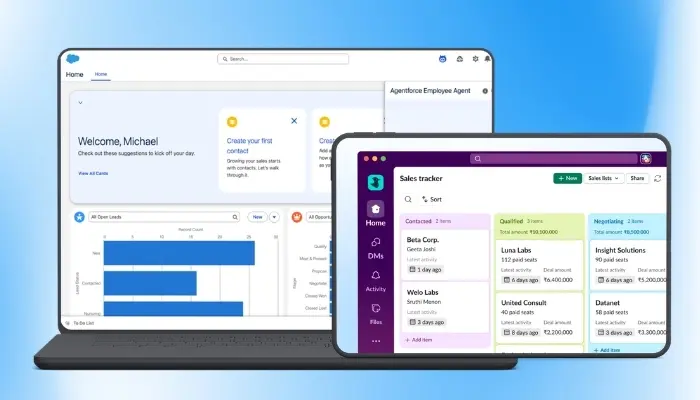
Each code channel is organised into four dedicated tabs. One tab holds the conversation, another displays the agent’s plan, a third shows line-by-line code diffs, and the fourth offers a live preview of the running output.
This structure allows teams to watch an AI agent build software in real time, rather than reviewing its work only after the fact. In turn, code generation, inline diff reviews, and live previews are consolidated within Slack, letting teams move a project from initial concept through to production without juggling multiple platforms.
Rob Seaman, EVP and GM of Slack, Salesforce, framed the launch around collaboration rather than individual productivity, “AI only creates value when it’s part of how a team actually works, not something people go do alone in another tab. Code channels bring that work into the open, where the rest of the team can see it, shape it, and build on it,” he said.
For business and technology executives, Salesforce positions Slack Code as a fix for the context loss and inefficiency that can occur when developers work with AI agents in private, isolated terminals.
By embedding agents into shared channels governed by existing enterprise security and IT admin controls, the company says organisations can convert private developer workflows into searchable, compounding institutional knowledge.
Non-technical teammates stand to benefit as well. Product managers, designers, and marketers will be able to trigger agents, review output, and guide development directly, which Salesforce says removes engineering bottlenecks for routine tasks and bug fixes.
Delivery speed is also central to the pitch. By eliminating context switching and approval friction, teams can use real-time previews and code diff reviews within Slack to approve and merge code more quickly.
Governance has not been left out of the design. Agents inherit Slack’s existing security model and admin permissions, which Salesforce says allows organisations to move faster without compromising compliance or creating separate IT approval bottlenecks for high-stakes actions such as production deployments.
On the technical side, tagging an AI agent in any conversation automatically provisions a project-based code channel. That channel then archives itself once the task is complete, while preserving a searchable audit log for later reference.
Meanwhile, human oversight remains built into the workflow. Anyone in a channel can pause, redirect, or stop an agent mid-task, and human sign-off is still required before an agent can push final changes to production.
Built on flexible APIs, Slack Code currently integrates with the five partner agents named above. Salesforce has also indicated that the feature will open up to custom enterprise agents across non-engineering functions, including legal and marketing.
Cat Wu, Head of Claude Product at Anthropic, pointed to the informal origins of much engineering work, “So much engineering work already starts as a conversation in Slack with Claude Tag: a bug report, a piece of feedback, a ‘what do you think about…’.”
“Slack Code gives teams a dedicated channel where the people, the context, and Claude work together from the start. Review the code diff and see a live HTML preview right in the channel, without anyone leaving the conversation”, she added.
On the other note, Rebecca Wettemann, CEO and Principal Analyst at Valoir Research, situated the launch within a broader industry conversation about AI return on investment. “For companies to unlock the full value from AI, it has to move beyond individual productivity gains to operational transformation. Slack Code enables AI to move beyond individual copilots to embedded, contextual AI orchestration to deliver real AI ROI at scale,” she said.
Moreover, Vercel’s Chief Technology Officer, Malte Ubl, emphasised how the feature changes the nature of collaborative coding. “Slack is already where our teams collaborate, and Code Channels bring that same collaboration into how we work with agents. A thread is great for a quick back-and-forth, but the work with an agent has gotten valuable and complex enough that it deserves its own space.”
“A whole team can gather in one Code Channel, watch the agent work, steer it together, and ship a preview, with all the context and history staying in one shared place. It turns building software from something that happens in one person’s local session into something the whole team does together,” he continued.
Furthermore, GitHub’s Chief Product Officer, Mario Rodriguez, linked the integration to GitHub’s own strategic direction. “Slack is a strategic part of a broader GitHub promise: humans set direction, agents close the loop. That has to be true wherever developers are working, which is why we’re bringing Copilot into the flow of conversation in code channels to help teams turn shared intent into shippable software,” he said.
Cognition’s President of New Enterprise, Jeff Wang, added that this drew a comparison between AI agents and human team members. “Agents earn their place on a team the same way people do, by knowing when to contribute and when to stay out of the way. With code channels, Devin responds in Slack autonomously, verifies its work by running end-to-end in cloud agents, and brings the right people together without cluttering the conversation,” he said.