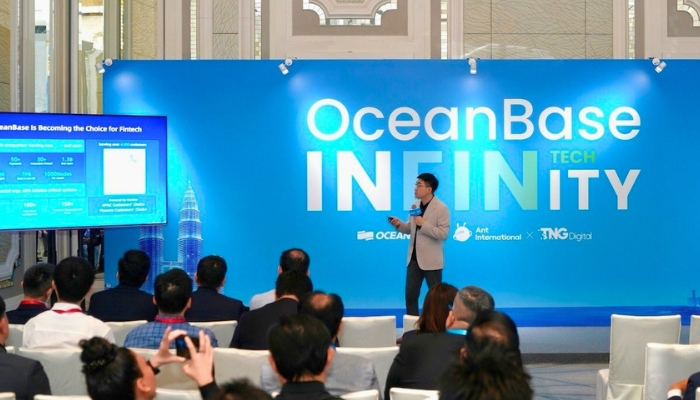

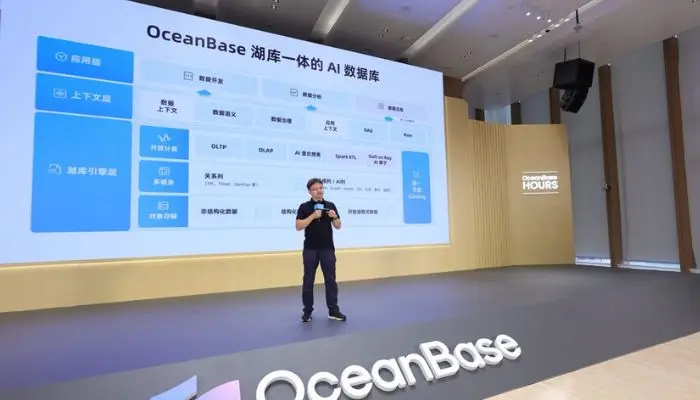
Singapore – OceanBase has launched ‘OceanBase AI Database’, a new enterprise data platform designed to help organisations manage multimodal data, provide AI agents with real-time access to trusted business data, and reduce the complexity of fragmented data architectures.
The launch reflects growing demand for data infrastructure that can support enterprise AI workloads as organisations move AI agents beyond experimentation and into operational environments. Rather than relying on separate systems for databases, data lakes, and vector storage, OceanBase is positioning its platform as a unified environment for managing different data types while supporting transactional and analytical workloads.
At the core of the platform is LakeBase, OceanBase’s architecture that combines data lake storage with database capabilities to manage structured, unstructured, and vector data within a single system. The company said the approach is intended to simplify enterprise data management while maintaining consistency and real-time performance for AI applications.
The release also includes DataStudio, a platform for data ingestion, governance, orchestration, and semantic modelling, and DataPilot, a natural language-powered business intelligence tool that enables users to generate reports, dashboards, and data insights without requiring technical expertise.
OceanBase said the platform is designed to address a common challenge facing enterprise AI deployments: while advances in large language models have improved reasoning capabilities, many organisations continue to struggle with providing AI systems access to consistent, governed, and up-to-date enterprise data. The company argues that conventional data architectures, which often separate transactional databases, data lakes, and vector stores, can make this process more complex.
According to OceanBase, organisations using the platform can reduce total cost of ownership by between 30% and 50% compared with traditional architectures. The company cited deployments at Ant Group’s AQ (Ant A-Fu) and Lingguang AI platforms, as well as enterprise customers including Lalamove, China Unicom, and Trip.com, which use OceanBase to support retrieval-augmented generation (RAG), hybrid search, and other AI-driven applications.
“As AI moves from answering questions to taking actions, databases must evolve from systems of record into trusted context engines for AI,” said Charlie Yang, Chief Technology Officer of OceanBase. “OceanBase AI Database is not about stitching together a data lake and database. It is about bringing multimodal data, real-time serving, transaction consistency, and open compute into a single architecture.”