
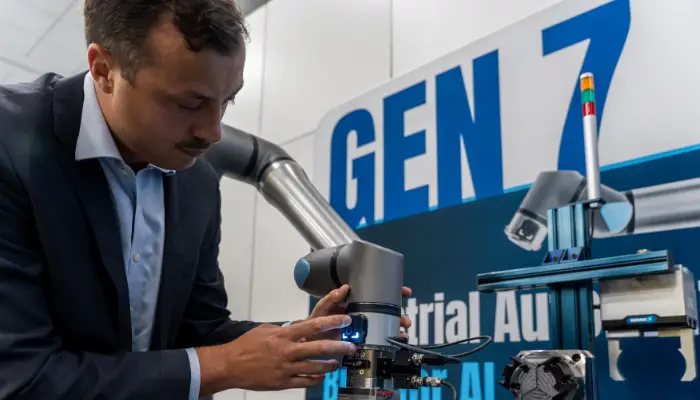
United States – Universal Robots has introduced its seventh-generation robotics platform, Gen 7, with new hardware and software designed to support artificial intelligence (AI) and physical AI applications in industrial environments.
The platform was unveiled at a trade show and includes a redesigned control box, teach pendant and tool flange, alongside updates to the company’s PolyScope X robot operating system.
Universal Robots said Gen 7 is designed to support the integration of AI, machine vision and sensing technologies into industrial automation. The platform combines new robot arms with additional computing, connectivity and programming capabilities.
“The robots of the AI era must be advanced, not complicated,” said Jean-Pierre Hathout, President of the Teradyne Robotics Group.
“Built on what we have learned from over 20 years of cobot innovation and more than 100,000 industrial deployments worldwide, Gen 7 is an end-to-end redesign of our platform that reduces integration friction and dramatically expands application capabilities. It will enable our customers and partners across industries to confidently deploy advanced AI-powered applications in real-world operations,” Hathout continued.
New robot arms and AI-ready interface
The Gen 7 platform introduces three new g-Series collaborative robot arms: the UR10g-1750, UR17g-1300 and UR18g-950. The models are named according to their payload and reach specifications.
The new g-Series tool flange is designed to provide data, power and safety connections for cameras and other high-bandwidth sensors. This allows sensing and vision technologies to be integrated more directly with the robot.
The robots also incorporate force-torque sensing, impedance control and Real-Time Data Exchange (RTDE), supporting applications that require physical interaction, including manipulation and force-sensitive assembly.
Increased computing and connectivity
Gen 7 also includes the CB7 Core controller, which Universal Robots said provides 40% more computing power while occupying 30% less space than previous generations.
The controller supports communication with programmable logic controllers (PLCs), human-machine interfaces (HMIs), manufacturing execution systems (MES), industrial PCs and vision systems. It is available in a standalone control box configuration and a compact version designed for automation cabinets.
The CB7 controller is also compatible with the company’s existing e-Series and UR Series robot arms.
PolyScope X provides programming tools, ISO 10218-1 safety functionality and cybersecurity features. Its open APIs and ROS2 communication capabilities are designed to allow developers to build edge-AI applications using industrial PCs and external AI processing.
Additional software packages support technologies including ProfiSafe and OPC-UA, while third-party application software can also be integrated through the platform.
Updates for operators
The TP7 Core teach pendant has been redesigned to be more than 20% lighter than previous generations. It includes multiple grip positions, configurable smart buttons, a full HD display and a virtual joystick.
Universal Robots has also introduced the SP7 Smart Panel, an interface located at the robot’s tool flange that allows operators to teach and programme tasks directly at the point of operation.
The panel includes freedrive functionality, LED indicators and three configurable input buttons that can run PolyScope X Smart Skills. The company said the design is intended to reduce setup and programming time for applications requiring direct operator interaction.
Safety and cybersecurity are also incorporated into the Gen 7 platform. Universal Robots said its g-Series robots have a PLd, Category 3 architecture certified under ISO 13849-1, while the robots are TÜV certified to ISO 10218-1 and UL1740.
Teradyne Robotics is also certified to IEC 62443-4-1 ML3 for cybersecurity development practices.
Physical AI ecosystem
At IMTS, Universal Robots is demonstrating Gen 7 alongside more than 20 ecosystem partners, including Cognex, Schunk, Magswitch, Smooth Robotics, Psyonic, Robotiq and Inbolt.
The demonstrations cover applications involving physical AI, machine vision and gripping technologies, highlighting the platform’s open architecture and integration with third-party systems.
“Universal Robots and Inbolt share the same conviction that automation should be simple to deploy and simple to live with,” said Rudy Cohen, CEO of Inbolt.
“With Gen 7 and PolyScope X, Inbolt’s vision now runs natively on the UR controller itself, available directly through UR. No external vision PC, no extra cabling. Manufacturers get parts localised without jigs or fixtures, and reach production in hours, not weeks,” Cohen continued.
Universal Robots said Gen 7 is supported by its UR+ ecosystem, which includes automation products that undergo validation by both the partner and Universal Robots before being made available to customers.
The company said it plans to use the Gen 7 platform to support broader deployment of AI-enabled automation, as manufacturers look to integrate robotics, machine vision, sensing and AI into production environments.