
Shenzhen, China – Tencent Cloud Enterprise (TCE) has introduced two private cloud solutions designed to help organisations in regulated industries deploy and operate agentic AI within their own infrastructure and data environments.
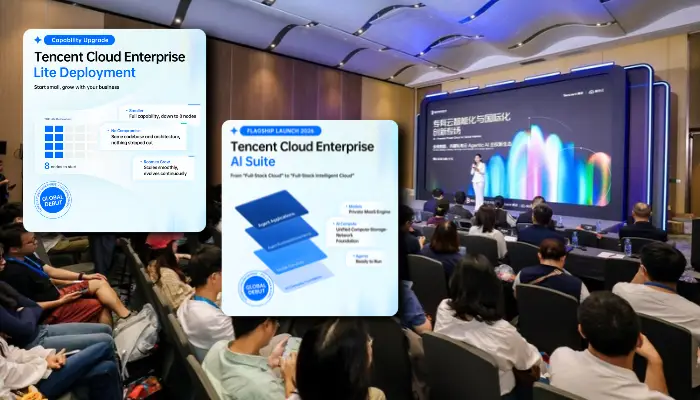
The offerings, the Full-Stack Intelligent AI Suite and Lite Deployment, provide infrastructure and software capabilities for businesses seeking to run AI workloads while maintaining control over their data, systems and operations.
The Full-Stack Intelligent AI Suite combines computing, storage and networking infrastructure with model services, agent runtime environments and application capabilities. Organisations can adopt individual layers or expand across the full stack as their requirements develop.
Its model service layer is built around TokenHub, a private platform for large language model (LLM) services. The platform provides a unified inference API, multi-tenant isolation and token-level usage metering for individual users and API keys.
Tencent Cloud Enterprise said built-in inference acceleration can deliver more than 250,000 tokens per minute (TPM) of measured single-accelerator throughput, cache hit rates above 90 per cent and throughput improvements of up to 220 per cent on alternative silicon.
The suite also includes cloud-native sandbox environments, outbound network controls and identity credentials for agent operations. According to the company, runtime environments can be provisioned within minutes, while unified training and inference scheduling can improve heterogeneous computing utilisation by up to 60 per cent.
The infrastructure is designed to keep data, model weights and inference traffic within customers’ designated sovereignty boundaries. It supports mainstream x86 and ARM processors, as well as accelerators from multiple vendors, and has been validated at a scale of 10,000 GPUs.
Tencent Cloud Enterprise also reported recovery time objectives (RTO) of two minutes or less and a recovery point objective (RPO) of zero, targeting resilience requirements for financial services environments.
Smaller entry points for private cloud deployment
The second offering, Lite Deployment, is designed to give organisations a smaller starting point for private cloud projects while allowing them to expand without replacing the underlying platform.
The full-stack cloud configuration starts with eight servers: three master nodes, three block storage nodes and two network function nodes. An AI-only deployment can start with three servers and includes private model services.
The architecture can scale from a single availability zone to dual availability zones with active-active operations, followed by cross-region disaster recovery. The software-based deployment can also run on existing hardware, avoiding the need for an immediate infrastructure refresh. Tencent Cloud Enterprise said the offering has no minimum spending requirement.
The company cited an unnamed futures brokerage among its customers, which deployed a full-stack private cloud for core trading systems across different chip architectures. The organisation began its AI deployment with three servers before expanding capacity as usage increased.
Research examines sovereign AI and telecommunications infrastructure
Tencent Cloud Enterprise also introduced two research publications developed with external industry research firms.
One examines the development of sovereign AI cloud platforms for regulated industries, including financial services, healthcare, public services and telecommunications. It describes sovereignty across three areas: data, operations and technology.
The research cites projections that more than 25 per cent of enterprises in regulated industries will be required to move their primary generative AI workloads back on-premises by 2028 due to data sovereignty and privacy regulations. It also highlights the risk of dependence on proprietary foundation models and a shortage of skilled professionals to support AI adoption.
A separate study examines the role of cloud and AI infrastructure in telecommunications. It identifies opportunities for operators to expand beyond connectivity services into industry cloud platforms, national cloud infrastructure and AI-based services.
The research projects US$160 billion in telecommunications-led AI data centre investment between 2026 and 2031, equivalent to 9 per cent of combined fixed and mobile capital expenditure. It also points to potential revenue models based on model-as-a-service and token-based services.
Customer deployments across markets
Organisations from several markets also shared examples of their deployments. These included a multi-chip government cloud infrastructure in Shanghai, an AI foundation supporting clinical and administrative workflows at Shenzhen Second People’s Hospital, and a hybrid cloud migration for a large organisation in Hong Kong.
A Thai digital infrastructure provider also deployed two data centres using Tencent Cloud Enterprise within eight weeks. The provider now operates a white-labelled cloud business with usage-based metering.