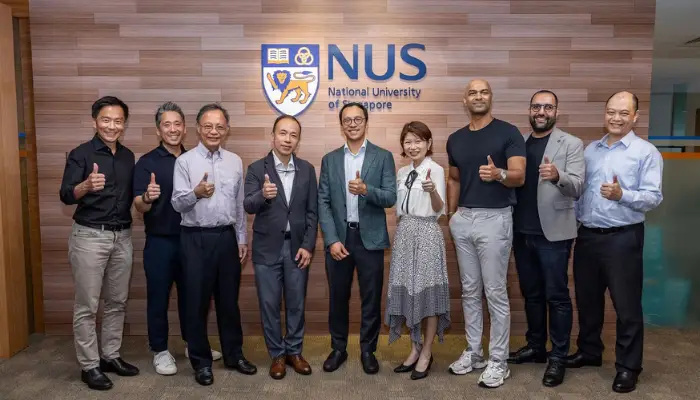

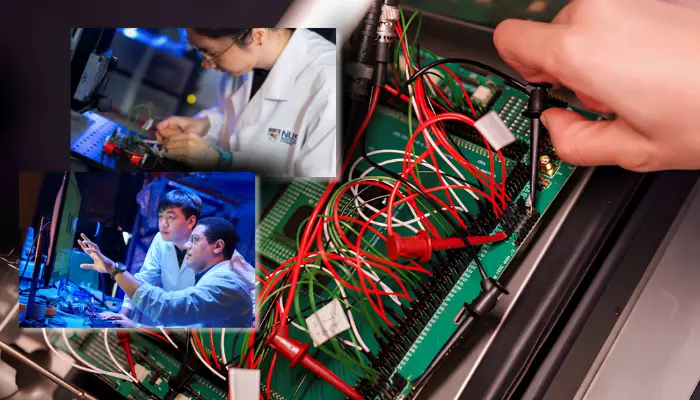
Singapore – Global semiconductor manufacturer STMicroelectronics N.V. and the National University of Singapore (NUS) have officially launched the ST–NUS HELIX Corporate Lab, a four-year strategic research initiative aimed at advancing next-generation edge artificial intelligence technologies.
Supported under Singapore’s Research, Innovation and Enterprise 2025 plan, the joint facility focuses on system-to-silicon innovation to support generative and embodied AI applications directly on physical devices.
The multidisciplinary programme integrates university research with semiconductor manufacturing capabilities, combining expertise across AI algorithms, accelerator architectures, circuit design, and silicon technologies.
“The ST–NUS HELIX Corporate Lab is a testament to the value of industry–academia partnerships in translating research into innovation,” said NUS President Professor Tan Eng Chye.
“By combining NUS’ research strengths with STMicroelectronics’ industrial capabilities, we are building not only advanced, cutting- edge AI hardware, but also the talent and ecosystem that will help define the future of Singapore’s semiconductor and AI industries,” Professor Tan added.
By processing data directly on or near physical hardware, edge AI minimises reliance on remote cloud infrastructure, improving real-time response times, energy efficiency, and data privacy.
The initiative specifically targets embodied AI applications, such as robotics, humanoids, and autonomous drones, which require real-time multi-modal sensing and on-device processing under strict power constraints.
“ST’s strength as an integrated device manufacturer lies in our ability to bring together advanced silicon technologies, embedded memory, circuit design, heterogeneous integration and chiplets,” said Laurent Malier, Executive Vice President of Global Technology R&D at STMicroelectronics.
“Through HELIX, we are creating an industrially relevant foundation to explore differentiated AI computing technologies and accelerate the translation of promising research into scalable semiconductor solutions,” Malier noted.
Research activities will utilise ST’s proprietary P18 18nm Fully Depleted Silicon On Insulator technology and embedded Phase Change Memory to reduce off-chip data transfer and total energy usage.
Furthermore, STMicroelectronics is providing NUS researchers with a dedicated design chassis implemented in its P18 technology to serve as an industrial-grade platform for validating new AI accelerator concepts.
Ms Low Yen Ling, Senior Minister of State for Culture, Community and Youth, and Trade and Industry, officiated the launch of the facility.
Beyond hardware development, the corporate laboratory aims to build a talent pipeline in chip design and AI systems engineering to strengthen Singapore’s long-term semiconductor ecosystem.