
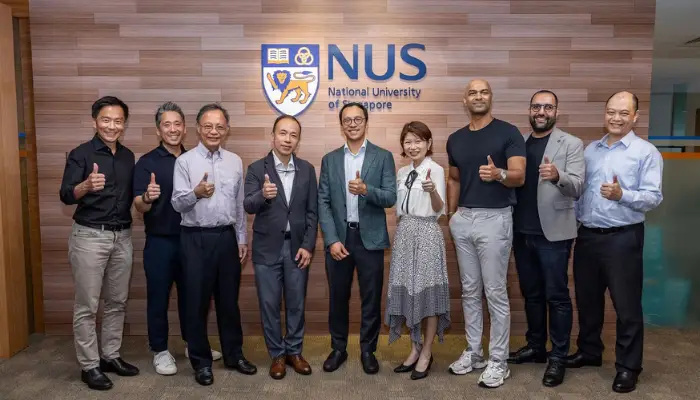
Singapore – The National University of Singapore (NUS) and OpenAI have announced a strategic collaboration aimed at expanding the use of artificial intelligence across education, research and administration at the university.
Under the collaboration, every NUS student, faculty member and staff member will have access to ChatGPT Edu and Codex, with enterprise-level security and controls. ChatGPT Edu will initially be piloted in selected courses before being introduced into undergraduate programmes where it can support learning objectives.
The partnership will also provide students with opportunities to participate in AI-focused hackathons and build days centred on real-world problems, while NUS researchers and OpenAI teams will explore potential research collaborations involving AI development and responsible applications.
The university will continue to use its internally developed AI-Know platform alongside OpenAI’s tools as it expands AI adoption across education, research and administration.
The announcement follows research commissioned by OpenAI involving more than 500 university students in Singapore. The survey found that 81% of respondents believe AI skills will give Singaporean graduates an advantage in the global workforce, while 77% said such skills would be essential to their careers.
The research also found that 94% of respondents use AI several times a week or more, with 55% reporting that they use AI multiple times a day. Meanwhile, 84% said AI literacy would become as fundamental as digital literacy, writing and numeracy.
Students also expressed interest in gaining more practical experience with AI. Some 95% said they wanted more opportunities to use advanced AI tools on real-world university projects, while 88% wanted to build an AI app, product or company while at university.
The survey found that 35% of respondents had already built their own AI agent or assistant to help manage their studies, work or personal lives.
The collaboration builds on an earlier partnership involving OpenAI and the NUS School of Computing. According to OpenAI, users at NUS have engaged more deeply with ChatGPT and adopted Codex at higher rates than users at similarly sized universities.
One example highlighted by OpenAI is Research Brain, a project developed by Gao Bin, a postdoctoral researcher in computer science at the NUS School of Computing, and his team.
The system uses Codex and OpenAI models to regularly find, read and organise research materials from sources including academic papers, technical reports, white papers, blogs and GitHub repositories. The resulting knowledge base allows the team to search across materials, compare experimental methods and explore connections between papers.
The project was developed as a side project to support the team’s primary research work, with Codex helping to accelerate the development of the research infrastructure.
“We aim to leverage these advanced AI technologies not as replacements, but as powerful amplifiers of human intellect, creativity and judgment,” said, Professor Aaron Thean, Deputy President (Academic Affairs) and Provost of NUS.
OpenAI also cited an AI-focused faculty hackathon conducted with the NUS School of Computing as an example of how educators are experimenting with AI tools.
Projects developed during the event included Video Assessment Coach, which uses recordings of student performances to generate evidence-linked feedback, and Continuum, a knowledge-graph tool intended to organise meeting notes, discussions and decisions.
Beyond expanding access to AI tools, the partnership will examine how AI can support teaching, research and other university activities while addressing questions around responsible adoption.
OpenAI said the collaboration forms part of its broader OpenAI for Singapore initiative, a multi-year partnership with the Singapore government intended to expand access to AI and strengthen Singapore’s applied AI capabilities.
As part of that commitment, OpenAI has said it plans to hire more than 200 applied technology and technical-success employees in Singapore in the coming years.
NUS alumni are already working at OpenAI. Jordan Seow, a 2021 graduate of the NUS School of Computing, is a Forward Deployed Engineer based in Singapore, where he works with organisations to apply AI capabilities to practical problems. Fellow NUS alumnus Sharan Thangavel has also joined OpenAI as a Forward Deployed Engineer in Singapore.
“Singapore has an extraordinary opportunity to shape how AI contributes to education, research and innovation, and NUS has an important role to play in that future,” said Oliver Jay, Managing Director, International at OpenAI.
The partnership comes as Singapore continues to develop AI capabilities across education, research and industry, with universities positioned to play a role in developing talent and exploring applications of the technology.