
Singapore – Okta has announced the general availability of Agent SSO, extending the Cross App Access (XAA) standard to its identity platform and allowing organisations to manage AI agents as first-class identities alongside human employees.
The offering aims to give security teams centralised control over AI agent access while reducing reliance on static API keys, unmanaged connections and repeated user consent prompts.
AI agent adoption is growing across enterprise workflows, yet only 34% of organisations apply the same identity and security controls to their agentic workforce as they do to human employees, according to Okta.
Historically, connecting AI agents to enterprise applications has relied on fragmented, point-to-point methods. As a result, agents can operate as anonymous network traffic without centralised visibility, administrative oversight or lifecycle audit trails.
Against this backdrop, Agent SSO uses Cross App Access, a standard that enables secure agent-to-app and app-to-app access. Initially led by Okta, the protocol has since been adopted by AI platforms, SaaS providers and identity partners.
Similar to how Single Sign-On centralised human access decisions at the identity provider layer, Agent SSO moves agent authorisation from individual applications to the enterprise identity provider.
In Asia Pacific, the shift is also taking place as organisations expand their use of AI agents while developing governance strategies for the technology.
“Across Asia Pacific, organisations are moving quickly to put AI agents to work, but many are still figuring out how to manage them. Okta research shows 91% of organisations are already using AI agents, yet only 10% have a well-developed strategy for managing them,” said Stephanie Barnett, Vice President, Presales, Asia Pacific & Japan, Okta.
“As agents connect to more enterprise applications and act on behalf of employees, organisations need to know where they are, what they can access and who they’re acting on behalf of. Agent SSO gives security teams a way to manage that access through the identity policies and controls they already have in place, rather than having to build a separate security model for AI,” Barnett added.
At the product level, when an XAA-supported AI agent connects to an enterprise application, Agent SSO registers it as a first-class identity in Okta’s Universal Directory, where it can appear alongside human employees.
For example, organisations using Anthropic’s Claude can manage its access through Okta by assigning, monitoring and updating security policies in the same environment used to govern human identities.
This centralised approach is intended to reduce the need for employees to share static credentials while limiting repeated consent prompts when AI agents access enterprise applications.
“Okta is an undisputed leader in SSO, and now we’re bringing SSO for your AI agents,” said Ric Smith, President of Products and Technology at Okta.
“AI agents are fast becoming a primary interface for how work gets done, but granting them access to enterprise systems shouldn’t require trading away security or visibility. With Agent SSO, we are helping to establish a fundamental security standard for the agentic enterprise. By treating every connected agent as a first-class identity and bundling this capability directly into our core SSO offering, Okta is making it effortless for enterprises to secure AI workflows from day one,” continued Smith.
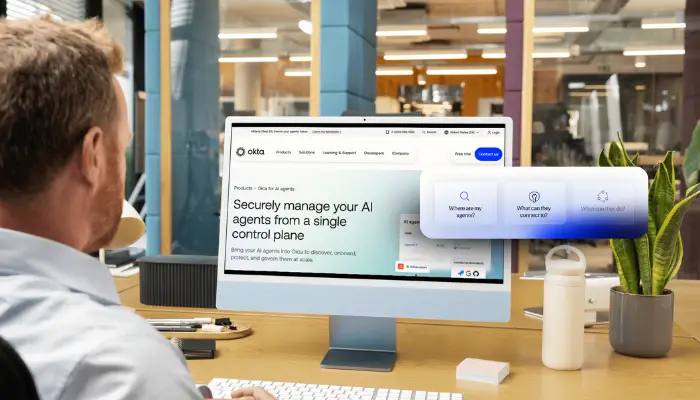
Beyond identity registration, Okta positions Agent SSO as a foundational layer within its blueprint for the secure agentic enterprise. The framework focuses on three governance questions: where agents are, what they can connect to and what they can do.
Agent SSO addresses the first two by registering XAA-supported agents as identities in Universal Directory and providing centralised visibility across platforms.
At the same time, the system uses identity-governed, short-lived tokens instead of hardcoded credentials and broad OAuth authorisations. These controls are designed to restrict agents to sanctioned applications, APIs, tools and Model Context Protocol (MCP) servers under least-privilege policies.
However, identity management represents only one part of securing AI-driven workflows. Okta said its Okta for AI Agents offering provides further visibility into unmanaged agents, supports lifecycle governance and enables organisations to enforce runtime controls.