
Every customer interaction depends on two things working together. The first is the telecommunications network that carries the call, the text message and the link. The second is the customer experience operation that picks up the conversation when something goes wrong. Both sit close to the customer, which makes them attractive to scammers. A fake message can arrive over the network long before a brand knows about it, and a hijacked account or a spoofed store often reaches a contact centre as a worried customer asking for help.
For telecommunications, the risk is one of scale and trust. Operators carry the calls and messages that fraudsters rely on, and they hold the identity and account data that makes impersonation convincing. For customer experience operations, the exposure comes from handling sensitive requests at volume, often through AI models, chatbots, payment tools and other third-party services that each add a possible way in. As personalisation widens the data in play and AI agents begin to act on behalf of consumers, a weakness in either layer can undo the trust the other has built.
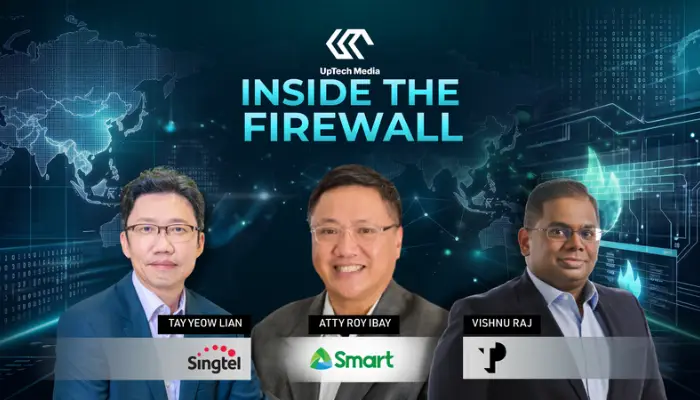
To look at how both layers are responding, this instalment of Inside the Firewall draws on the views of three industry leaders. Tay Yeow Lian, Chief Technology Officer at Singtel Singapore, speaks from the network operator’s side. Vishnu Raj, Vice President for AI and Analytics of Teleperformance (TP) Philippines, brings the view from customer experience operations. Atty Roy Ibay, Vice President and Head of Regulatory Affairs at Smart Communications, adds the telecom perspective on accountability and regulation. Together, their answers show where customer trust is protected, where it is put at risk, and why security has to cover the full path from the network to the contact centre.
The network stops scams early
For a telecom operator, security starts earlier than it does for most brands. Calls, text messages and links all pass over the network before they reach a customer, which gives an operator a view of threats that a retailer or a service desk rarely has. Tay begins with why that position matters as businesses lean on AI for more personal service.
“Personalisation and security need to evolve together. As businesses use AI to deliver more relevant services and seamless customer experiences, they also need to strengthen security to maintain customer trust,” Tay said.
That thinking shapes how the operator protects its customers. Instead of leaving people to spot threats on their own, Singtel Singapore works at the network level to detect and block malicious websites, phishing links and scam calls and messages before they arrive. The aim is to keep genuine interactions seamless while making it harder for criminals to exploit customer accounts and data.
Fraud, however, rarely waits for the checkout, which makes the point at which a business steps in a critical question. Tay said protection cannot be limited to the moment of payment.
“Businesses need to protect their customers at every stage of the shopping journey – from their first interaction to payment and after-sales support. Fraud can happen well before a customer reaches the payment page, through impersonated websites, fake advertisements or compromised accounts,” Tay said.
Impersonation is the common thread in those examples, which is why recognisable signals matter as much as blocking. Messaging offers a practical case in Singapore, where businesses that text customers under a brand name are asked to register it.
“Businesses that send SMSes using alphanumeric Sender IDs must register them with the registry. The system labels messages from unregistered Sender IDs as ‘Likely-SCAM’, helping customers identify potentially suspicious messages,” Tay said.
For customers, a label like this removes some of the guesswork. For brands, it turns being easy to identify into part of the security design. The network can act early and make real businesses easier to recognise, so customers are not left to judge every message alone.
The network can catch much of what is sent, but not everything that gets through. What does arrive often lands with a customer experience team, which is where Vishnu Raj of TP in the Philippines picks up.
The contact centre handles what gets through
Where the network leaves off, the contact centre begins. Scams that slip past the first line of defence, hijacked accounts and fake stores all end up as live conversations with customers who want answers, and customer experience operations are expected to handle them at volume. Raj says the response has to combine machines and people.
“AI can help identify fraudulent stores, suspicious activity and emerging scam patterns at scale, while human moderation ensures appropriate intervention before these threats become widespread. For account hijacking and phishing, stronger cybersecurity protocols, authentication mechanisms and consumer awareness are essential,” Raj said.
That approach is set to stretch further as AI agents begin to browse and transact for consumers, which puts the tools themselves in the line of fire. Every model, plugin and payment integration an operation relies on is another place for a weakness to sit, so Raj argues that checking them cannot end at launch.
“Security cannot be a one-time certification. It needs to be a continuous capability within the organisation,” Raj said.
For a service operation, that means testing and monitoring become part of daily work, owned by dedicated internal teams and not a box ticked before go-live. The cost of falling short is also not always visible straight away. A single incident may not change how customers buy, yet the damage can build over time, and a heavy-handed response can hurt the experience too.
“The real risk is cumulative. Repeated incidents can progressively erode confidence, while overly restrictive security measures introduced in response can also damage the customer experience,” Raj said.
That balance is the daily test for any contact centre: protect the customer without making help harder to reach.
Handling incidents well is one part of the picture, and being accountable for them is another. Atty Roy Ibay of Smart Communications turns to what a telecom owes its customers before and after something goes wrong.
A telecom answers for every channel
A telecom operator is both the channel customers use and a brand with customers of its own, and it works under regulatory scrutiny. That double role means its security choices are judged by customers and regulators alike. Atty Ibay starts with the cost of personalisation.
“Personalisation runs on data, so every tailored or customised experience widens the possible threat or attack surface. Security done well alongside personalisation will reinforce each other: customers share more and will cater to brands they trust and know offer robust protection,” Ibay said.
In his view, the response starts with the channels a business controls. Customers should be able to tell a genuine message from a fake one, which puts the work of proving authenticity on the brand and not on the customer.
“Brands should authenticate their own channels, monitor for spoofed domains and fake stores, enforce multi-factor login, and regularly post bulletins and warn customers early about phishing. Fast takedowns and clear reporting lines matter just as much,” Ibay said.
The perimeter extends beyond a brand’s own channels. Ibay treats every AI tool, plugin, payment service and chatbot as part of the operating perimeter, which means vetting vendors, limiting the data they can reach and monitoring them continuously. He also says a plan for a breach or security incident should be ready before a partner is ever compromised, since a weakness in a partner becomes the brand’s problem as soon as customers are affected.
When something does go wrong, the test is how the business responds. Ibay says trust is slow to win back, and an apology alone does not repair it.
“Trust can rapidly erode in a single breach and take many years again to rebuild. Recovery demands prompt disclosure, regulatory accountability, practical remedies for affected customers, regular audits and visible, lasting improvements and not just apologies and account rectification,” Ibay said.
For a telecom, that accountability covers the whole path, from the messages it sends to the partners it relies on and the way it responds after an incident.
What’s next is security built into the experience
Looking ahead, the three leaders point to the same shift. Protection is moving out of the customer’s hands and into the network, the platform and the service operation. Each places the responsibility in a different spot, but none expects shoppers to defend themselves alone.
Tay Yeow Lian of Singtel Singapore says customers still have a part to play as AI makes scams more convincing.
“As AI makes scams more convincing, we can’t expect consumers to become cybersecurity experts, but we do need them to be informed and vigilant. They should avoid unfamiliar websites and sellers, use strong authentication, keep their devices updated and check suspicious requests through official channels,” Tay said.
Atty Roy Ibay of Smart Communications turns to what brands can do to make safe habits easy to follow.
“Shoppers should use unique passwords, Multi Factor Authentication, and verify sellers before paying. Brands on the other hand can make this easier with passkeys, privacy compliance, clear cyber security safeguards, plain-language alerts, and clear, simple, and direct channels to report suspicious activity,” Ibay said.
Vishnu Raj of TP in the Philippines widens the lens to the platforms where shopping happens.
“Consumers, meanwhile, need to remain vigilant about suspicious sellers, links and payment requests. Ultimately, security should be built into the shopping experience, rather than becoming another responsibility pushed onto the consumer,” Raj said.
**
What stands out is that each leader begins at a different point on the same journey and reaches the same conclusion. Singtel Singapore starts at the network, where a scam can be stopped before it reaches a phone. TP in the Philippines starts at the contact centre, where whatever slips through becomes a conversation with a worried customer. Smart Communications starts with accountability, where a telecom answers for the channels it runs and the partners it relies on. Their safeguards form one chain of protection, and a gap at any link weakens the rest. None of them expects the customer to carry that chain alone.
For businesses, this raises three questions to settle before the next scam campaign arrives. Where does a threat first reach your customers, and who can stop it early? When something gets through, can your service teams act quickly without making help harder to reach? And when a partner, plugin or chatbot fails, who answers to the customer, and how soon? The brands that can answer all three will not be the ones asking customers to be more careful. They will be the ones whose security is built so well into the journey that customers rarely have to think about it, and that is how trust grows.