
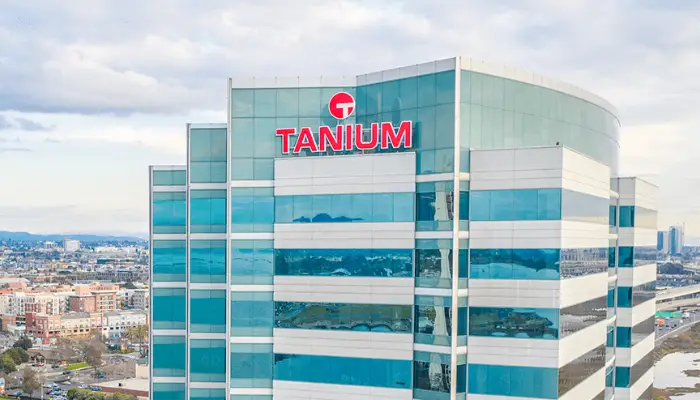
Singapore – Tanium has extended its endpoint management platform to NVIDIA‘s local AI hardware, allowing enterprises to monitor and control RTX Spark, DGX Spark, DGX Station, and DGX Station for Windows systems alongside the rest of their fleets, the company said.
The collaboration covers RTX Spark, NVIDIA’s Windows AI PC platform, as well as the compact DGX Spark and the deskside DGX Station, including its newly announced Windows variant. Tanium says support currently spans DGX Spark and RTX Spark, and is expanding to both DGX Station models.
The move targets a management gap that is widening as AI compute shifts from the data centre to the desktop. DGX Spark runs NVIDIA DGX OS, an Ubuntu-based Linux distribution built for AI workloads, which sits outside the Windows and x86 environments around which most enterprise management platforms are built.
Tanium says its platform gives operators visibility into inventory, running processes, patch status and compliance across these devices. The company also says it validated the platform on NVIDIA DGX OS, with patching, asset inventory, configuration compliance and process management working from day one and requiring no custom build.
In addition, the Tanium Autonomous IT Platform is named in NVIDIA’s DGX Spark Enterprise Lifecycle Integration Guide. Tanium says it is among the first endpoint management platforms to govern on-device AI agents at both deployment and runtime.
“NVIDIA’s vision for AI compute is bringing a new class of endpoint into the enterprise, including new hardware architectures, new operating systems, and AI agents running locally on all of them,” said Harman Kaur, Chief Technology Officer of Tanium.
“To manage that infrastructure with confidence, IT and security operators need real-time visibility and control across their entire fleet. Tanium extends that capability to NVIDIA’s AI endpoints the same way we have extended it everywhere else. With attacks now moving at machine speed, there’s no room for blind spots,” Kaur added.
Tanium will detail three capabilities at NVIDIA GTC Berlin, each validated in lab testing with supported NVIDIA hardware. The first, fleet-level consumption monitoring, shows which models are running, how much compute and memory they consume, and whether units operate within expected parameters.
The second, runtime control, lets IT and security operators start, monitor and automatically kill AI agents that exceed a defined time or resource threshold. Tanium says this applies policy-layer limits to running processes rather than to configuration state alone.
The third, agent deployment at scale, uses Tanium Deploy to push AI agents as packages or processes across an entire fleet simultaneously. According to Tanium, its linear-chain architecture scales linearly as fleets grow from dozens to thousands of units.
Beyond those features, the platform tracks process activity and resource use, including CPU, memory, GPU and temperature, across the fleet. It also offers CIS benchmark hardening, compliance reporting mapped to CIS and NIST frameworks, and continuous software bill of materials (SBOM) tracking across system packages, containers and language runtimes.
Tanium adds that operators receive just-in-time privileged access with full session recording for audit, without requiring SSH. Air-gapped deployment support, the company says, extends these capabilities to regulated environments.
NVIDIA, for its part, framed the work as an extension of its enterprise platforms into IT operations. “NVIDIA DGX and RTX platforms bring powerful local AI to enterprise developers and employees, enabling them to build and run AI within their established workflows,” said Chris Marriott, Vice President of Enterprise Platforms of NVIDIA.
“Our collaboration with Tanium extends that integration to IT operations, helping organisations incorporate these platforms into fleet management processes they already use as they deploy AI compute at scale.”