
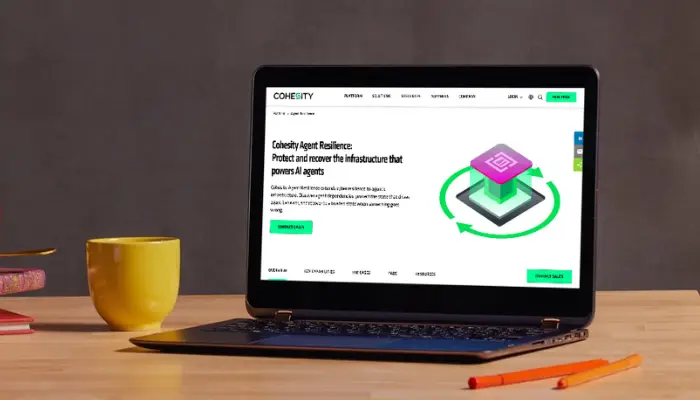
Singapore – Cohesity, a provider of AI and data security solutions, has recently introduced Cohesity Agent Resilience, a new Cohesity Data Cloud capability designed to discover, protect and recover the infrastructure behind enterprise AI agents.
The company also outlined its vision for Autonomous Cyber Resilience, which uses agentic workflows to automate its five-step cyber resilience framework covering data, identity, application and agent protection, recoverability, threat remediation, recovery practice and risk posture optimisation. Cohesity introduced the capability, the vision and a new AI Resilience Academy at Cohesity’s event.
According to Cohesity, Cohesity Agent Resilience is available now to select customers, with general availability targeted for the end of 2026. At launch, it supports Amazon Bedrock AgentCore and Amazon Bedrock Agents, with Microsoft and Google agent platforms on the roadmap.
The company said AI agents across the enterprise are querying databases, updating workflows and using privileged credentials, often without a person reviewing each action. It cited a Gartner prediction that up to 40% of enterprise applications will include integrated task-specific agents by 2026, up from less than 5% previously.
Cohesity said governance and observability tools can identify unexpected behaviour but cannot restore data or systems after an agent has changed, corrupted or deleted them, and that Agent Resilience is designed to address that recovery gap.
Cohesity also referenced findings from its fifth annual report, noting that 56% of organisations said they were not well prepared to detect or contain unintended actions by AI agents and automated workflows, while 58% were not very confident in their ability to verify the integrity of AI models and related data following a cyberattack.
“Detection can tell you an AI agent went off course. It cannot undo the changes. Cohesity Agent Resilience provides a precise recovery path for both the agents and the resources they impact. Our vision for Autonomous Cyber Resilience is to use agentic workflows to reduce manual work from response and recovery,” said Vasu Murthy, Chief Product Officer at Cohesity.
Protecting the infrastructure behind AI agents
Cohesity said an AI agent’s behaviour depends on components including agent memory, configuration, credentials, guardrails and workflows. At launch, Agent Resilience protects agent memory and configuration using the same snapshot architecture, immutable backups and clean-room recovery that the company says its customers already use to protect workloads and data across on-premises, cloud and SaaS environments.
The capability includes two core functions, according to Cohesity: protecting agent state, which offers point-in-time recovery to restore agents to a known-good state following memory corruption, misconfiguration or malicious activity; and protecting what agents manage, covering databases, file systems and other services agents interact with, to enable recovery of affected resources when needed.
Cohesity said agent topology gives teams a unified view of each agent, including its memory stores, connected applications, databases and supporting infrastructure, making it easier to assess protection coverage and identify resources required to restore operations during incidents.
“As AI agents take on more business-critical work, we need to think beyond monitoring and make sure we can recover when something goes wrong,” said Srikanth Kuntamukkala, CIS Global Lead for Partner Sales at Cognizant.
“Being able to restore an agent’s state, and the data it may have changed, could give our teams a more practical way to manage that risk as we move agentic applications into production,” Kuntamukkala continued.
A path towards Autonomous Cyber Resilience
Cohesity also set out how agentic workflows could help operationalise its five-step cyber resilience framework, aiming to move from manually configured, point-in-time plans towards a system that continuously discovers and protects data, validates recovery readiness and adapts response and recovery plans as conditions change, with a human in the loop.
Under this model, teams would define objectives through Cohesity Copilot rather than manually configuring policies across applications. Cohesity Data Cloud would then assess the resilience posture of relevant workloads, recommend protection policies, threat-scanning strategies and recovery-rehearsal plans, and present these for approval before execution. During a cyber incident, administrators could initiate automated response and recovery workflows to assess the scope of impact, identify indicators of attacker activity and prepare an isolated recovery environment.
As a step towards this model, Cohesity said customers with Cohesity Data Cloud Enterprise Edition and Cohesity DSPM can now automate the protection of newly discovered sensitive data that is not already protected, with Cohesity continuously discovering and classifying sensitive data, evaluating its protection status and triggering protection actions based on policy.
The Autonomous Cyber Resilience model builds on Cohesity RecoveryAgent, which the company said orchestrates parts of incident response and recovery. Cohesity Maestro, with expanded capabilities expected later in 2026, will connect Cohesity’s protection, response and recovery capabilities to customers’ preferred AI tools, including Claude, ChatGPT and Gemini, as well as Cohesity Helios, the company’s unified management console.
“Cyber resilience is not a one-time assessment. It requires teams to protect data, test recovery, detect threats, rehearse responses, and continually improve their risk posture. Agentic workflows can take on more of that routine work and help keep the plan current,” Murthy said.