
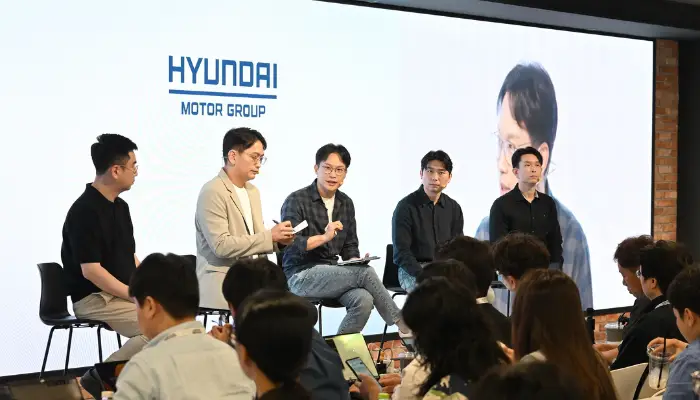
South Korea – Hyundai Motor Group has outlined a roadmap for advancing autonomous driving through an AI-powered data strategy, including plans to expand Level 2+ and Level 2++ vehicle technologies while developing its proprietary Atria AI platform.
A central part of the strategy is the Group’s Data Flywheel, which is designed to create a continuous cycle of real-world data collection, AI training, validation and deployment. Hyundai Motor Group said the approach will allow driving data to be used to identify challenges, improve AI models and feed updated capabilities back into vehicles.
The Group is pursuing a dual-track approach to autonomous driving. Its collaboration with NVIDIA will support the development of production vehicles using NVIDIA-based Level 2+ technology, with production targeted for the first half of 2028, followed by Level 2++ vehicles in the second half of the year.
Hyundai Motor Group is also developing its own autonomous driving technologies through Atria AI, with Atria AI-powered Level 2++ vehicles targeted for the second half of 2029.
The strategy involves Hyundai Motor, Kia, 42dot and Motional progressively standardising sensors and combining autonomous driving capabilities across the Group. Hyundai Motor Group said this is intended to support a more consistent technology foundation across its autonomous driving programmes.
The Group is also expanding its data ecosystem through its annual sales of around seven million vehicles and a Data Union framework. Its development approach includes hard example mining, continuous training and simulation, evaluation and refinement (SER) processes to improve AI performance using real-world driving data.
As part of its autonomous driving development, Hyundai Motor Group plans to launch a Level 4 pilot in Gwangju by the end of 2026 in partnership with South Korea’s Ministry of Land, Infrastructure and Transport. The pilot is expected to provide additional real-world validation data for the development of higher levels of autonomous driving.
42dot also presented progress on its Vision-Language-Action (VLA) technology, which combines visual information with language-based reasoning to support driving decisions.
The VLA research is focused partly on handling edge cases that can be difficult for autonomous driving systems. 42dot is developing VLA and end-to-end (E2E) autonomous driving models in parallel, with the aim of improving technical stability and scalability.
Validation of the VLA model is currently underway, with on-road testing and further development scheduled to continue through early 2027.
The Group also showcased footage of an Atria AI-equipped software-defined vehicle (SDV) testbed navigating complex urban traffic without driver intervention. The vehicle demonstrated Level 2++ capabilities, according to Hyundai Motor Group.
The company said the footage illustrates how real-world driving data can be incorporated into the Data Flywheel to support ongoing learning, validation and performance improvements.
“Autonomous driving competition is no longer about comparing specific features. Competitiveness is determined by how much data you secure, how quickly you learn and how effectively you can reflect those results in actual products and services,” said Minwoo Park, President and Head of Advanced Vehicle Platform (AVP) Division at Hyundai Motor Group and CEO of 42dot.
“At its core, autonomous driving competitiveness comes down to having systems that enable continuous, rapid learning. Hyundai Motor Group will develop autonomous driving technology that customers can trust, based on a virtuous cycle of data, AI and validation. Our goal is to ensure the safety and quality levels customers can trust while we learn and improve rapidly,” Park continued.
The roadmap reflects a broader shift in autonomous driving development towards data-centric AI systems, with manufacturers increasingly using real-world driving information to train, test and refine autonomous driving technologies.