

Across Southeast Asia, the Philippines remains one of the most digitally active nations, with smartphones leading connectivity through social media and super apps dominating digital spaces.
Prominent organisations nationwide are also gradually adapting AI tools to streamline customer experience journeys, introduce AI initiatives, and increase awareness to strengthen cybersecurity capabilities.
Although when compared to neighbouring nations, the Philippines is still at an early stage of maturity when it comes to preparedness in adopting and integrating AI technologies to enhance customer experience across industries.
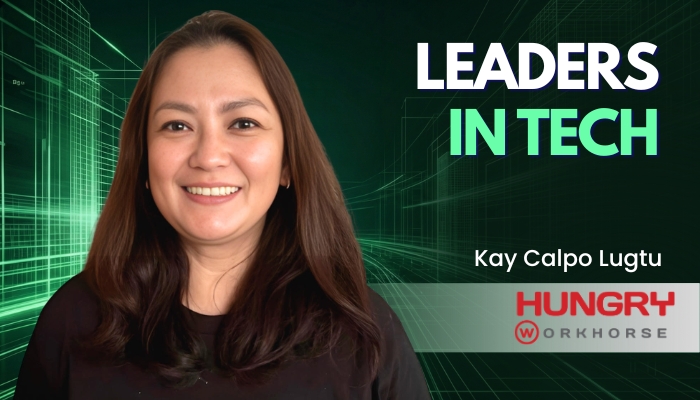
Working in the technology industry for nearly two decades, UpTech Media had the opportunity to speak with Kay Calpo Lugtu, Founder and COO of Hungry Workhorse, who highlighted the significance of cultural transformation to enable a sustainable pathway forward in digital transformation across the Philippines.
As an industry leader in the tech scene, Kay held several positions at IBM, Oracle, and Tata Communications before launching Hungry Workhorse. The organisation, which recently celebrated its 10-year anniversary, is focused on helping businesses train, upskill, and develop successful digital transformation initiatives across technology and culture.
Navigating the digital paradox
For Kay, the Philippines falls within an area of digital paradox, being one of Southeast Asia’s most online populations, yet many organisations still treat AI in customer experience as mere ‘front-desk’ accessories.
This is evident with the surge of chatbots to answer FAQs and AI that triage customer services—all very useful and reactive, but not transformative.
In order for digital transformation to have real impact and successful outcomes in the Philippines, Kay emphasised a need for a shift towards the approach for intelligent tools.
“Our neighbours are not just using AI to answer questions. They are using AI to reduce friction before it appears, retain customers before churn happens, and create experiences that feel intuitive,” Kay explained.
Across the region, Kay highlighted how the leading use cases of AI in customer experience are nations that move from reactive to predictive—from responding to customer needs to anticipating them. Nations that move ahead understand how AI can be integrated and treat it as a deliberate capability, built on data, embedded workflows, measured by outcomes and not just bolted onto legacy workflows.
Singapore is a great example of a nation that has embraced all aspects of AI with proactive and sustainable initiatives, with the National AI Strategy 2.0 and the Model AI Governance Framework for AI agents.
“If we stay stuck in ‘service as response’, we won’t merely fall behind—we risk being priced out and outpaced in the market that moves fast and punishes slow learners,” she added.
Disrupting cultural norms
One of the primary barriers to the progression of digital transformation in the Philippine market relates to several deep-rooted cultural aspects when it comes to integrating new technologies such as AI.
“The biggest barrier to AI adoption in the Philippines is often not budget. It is behaviour—a pattern of inertia that looks harmless until it compounds into irrelevance,” Kay explained.
Adopting AI technology not only takes a predictive approach, but also takes a significant amount of commitment to develop and mature through testing, learning, and refining. Avoiding visible mistakes due ‘hiya’ (shyness) and accommodating the perfectionism trap enabled by the ‘wait-and-see reflex’ are just some examples of cultural norms that inhibit innovation in digital spaces across the Philippines Kay emphasised.
“Many leaders want AI to be ‘proven’ before moving. But in AI, ‘proven’ often means someone else already built the advantage,” Kay added.
“AI is, by design, a learning system. If the organisational instinct is to avoid embarrassment rather than absorb learning, AI will never move past the pilot stage.”
In order to overcome these digital innovation hurdles, Kay believes that acknowledging an infrastructure mindset over the pressure for immediate short-term ROI is essential for nurturing evolving technologies to mature and develop to leave long-term high-value impact.
“Real AI capability is usually invisible at first—it lives in data discipline, process redesign, governance, and the unglamorous work of cleaning, connecting, and standardising systems.”
Embracing the hybrid model
As Hungry Workhorse aims to uplift Filipino capabilities in the Philippines and across the global stage, Kay highlights how one way she is working with organisations is to embrace the synergy between AI technologies and human intervention.
“The new gold standard is not just AI alone. It’s a hybrid: AI does the pattern detection, routing, drafting, summarsing, and prediction. Humans do the nuance—judgment, empathy, and relationship repair. This is where the Philippines can win with an existing service culture, AI simply gives it superpowers,” Kay commented.
Beyond the collaboration between AI and humans, Kay also shared how it is also an imperative for local organisations to understand how to democratise innovation; bringing innovation to the frontlines where the real work happens such as claims, collections, onboarding, and retention. This enables intelligent adoption to become practical, not ideological.
Most importantly, Kay always emphasises the importance of what it looks like to action urgency over comfort with local organisations.
“Leaders must communicate an uncomfortable truth: the status quo is not safe. In a region accelerating its digital capabilities, doing nothing is the highest-risk option,” Kay stated.
She followed with, “Beyond company walls, reforms in infrastructure and education are not ‘nice-to-haves’—they are the baseline requirements for national competitiveness.”
****
While the Philippines gradually matures through digital transformation, Kay and the Hungry Workhorse team continue elevating Filipinos at the local and international stage while supporting organisations to overcome the cultural hurdles to open a pathway for growth in digital transformation.
The goal is to scale transformation beyond the corporates, treat data as an asset, not a possession, and have shared standards and readiness to enable Phlippine organisations to collaborate on common AI standards—where one company does not dominate but rather ensures the Philippines remains relevant in the AI era.