
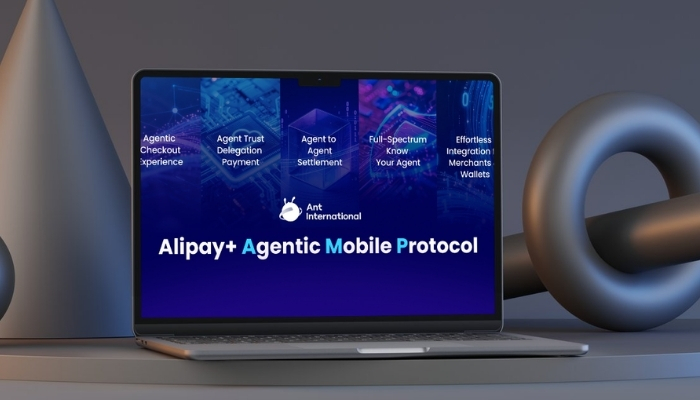
Singapore – Ant International has introduced the Agentic Mobile Protocol (AMP), an open-source framework designed to support AI-driven commerce through mobile-based payment services. The system is intended for use across digital wallets, banking applications, super apps and connected devices such as wearables.
The protocol has been developed to allow LLMs, merchants and digital platforms to connect more efficiently with mobile payment ecosystems. It aims to provide a standardised method for integrating AI agents with services used by an estimated 4.4 billion digital wallet users globally.
Industry forecasts cited by the company suggest the global market for agentic commerce could approach US$28b by 2030, supported by rapid growth in autonomous transaction systems. Digital wallet adoption is also expected to continue rising, with more than six billion users projected worldwide by the end of the decade.
“An agentic protocol for mobile commerce that ensures superior efficiency and security results will be key for businesses large and small expanding into the world’s fastest growing markets,” Jiang-Ming Yang, Chief Innovation Officer, Ant International, stated.
“We look forward to expanding our multi-layered partnerships to enable real-world successes of AI commerce.”
The company mentioned how existing AI payment systems have largely been built around card networks, while mobile payment platforms require different approaches for authentication, settlement and transaction management. AMP has been developed to address these needs in mobile-first environments.
The AMP framework enables merchants, AI developers and platform operators to embed payment capabilities into their services without requiring major changes to existing systems. By releasing the protocol as open source, Ant International said it intends to encourage the development of common technical standards for secure AI transactions.
The protocol includes several functions intended to improve user experience and operational efficiency. These include faster integration between payment agents and digital wallets, support for multiple device types, including smartphones and smartwatches, and transaction safeguards for payment partners in cases of unauthorised account access.
Additionally, the framework also includes a delegation model designed to let users authorise AI agents to complete tasks such as purchases, bookings and travel arrangements, while allowing permissions to be changed or withdrawn. In addition, the system supports automated micro-transactions between AI agents, including very low-value payments with real-time accounting.
Another component of APM is a Know Your Agent framework, which is designed to establish digital identities for AI agents and verify the activities they are authorised to perform. A trust rating mechanism is also intended to assess risk levels and determine the degree of autonomy permitted.
Ant International said it is working with partners connected through Alipay+, its global wallet network, to support adoption of the protocol. The Alipay+ platform links more than 40 digital wallet partners, representing around 1.8 billion user accounts and 150 million merchants worldwide.
Mastercard and Visa are involved in pilot programmes focused on card-based AI transaction capabilities, while collaborating with Google on broader standards for agentic commerce and payments.