
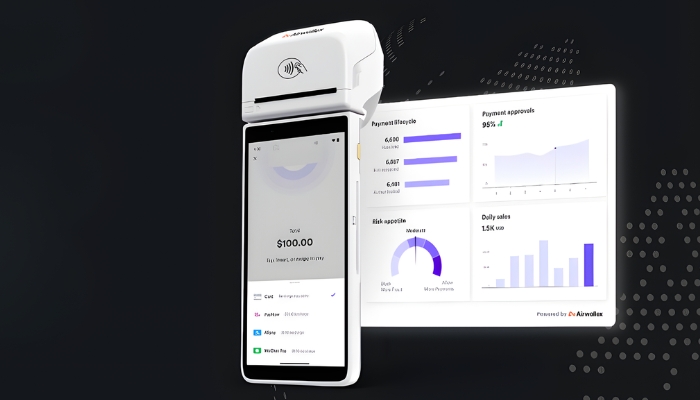
Singapore – Airwallex has introduced a new point-of-sale (POS) payments solution designed to address existing challenges across the retail industry by integrating in-store transactions into its existing global financial platform.
The system is currently available in Singapore, Hong Kong, the United Kingdom, parts of Europe, with plans to extend availability to the United States and Australia.
Conventional POS systems have typically been developed with a focus on single-market deployment and hardware-based setups, limiting their adaptability to evolving payment methods and cross-border operations.
As a result, businesses often encounter separate infrastructures for online and physical transactions, extended integration timelines with enterprise systems, and additional compliance and vendor management requirements when entering new regions.
The new POS solution seeks to unify online and in-store payment processing within a single framework. It supports integration with existing business systems through application programming interfaces and software development kits, enabling compatibility with established POS, order management, and enterprise resource planning platforms.
The platform also facilitates access to local payment methods across different markets through a single integration.
“We’ve been working closely with Airwallex for the launch of our new self-ordering kiosks,” Zhong Xu, Co-founder and CEO of Deliverect, shared.
“Airwallex’s SoftPOS capabilities enable us to accept payments directly through our ordering solutions without adding new payment hardware, helping us build an even better customer experience than we previously could.”
The system includes support for Soft POS functionality, allowing payment acceptance through mobile devices without the need for dedicated hardware. This approach is intended to reduce deployment complexity and enable broader adoption across various business models.
For enterprise retailers, the platform provides a consolidated view of transactions across channels and geographies, while simplifying reconciliation processes.
Meanwhile, for software providers, it enables the integration of in-person payment capabilities within their applications, potentially reducing development requirements and supporting additional financial service features such as accounts, payouts, and card issuance.
The platform is being adopted by companies in sectors including hospitality and retail technology, with implementations focused on integrating payment acceptance into existing digital ordering and service systems.