
Shanghai, China – Huawei has unveiled an upgraded version of its Stellar AI Network Solution, introducing changes across data centres, wide area network (WAN) and campus networking to support the growing demands of AI computing and agent-based applications.
The solution focuses on improving computing efficiency, network performance and security. Huawei said the upgrades are intended to address rising AI workloads, with daily token consumption having increased 260-fold over the past year, according to the company.
The upgraded solution comprises Stellar AI Fabric 2.0, Stellar AI WAN and Stellar AI Campus Network.
Stellar AI Fabric 2.0 targets data centre performance
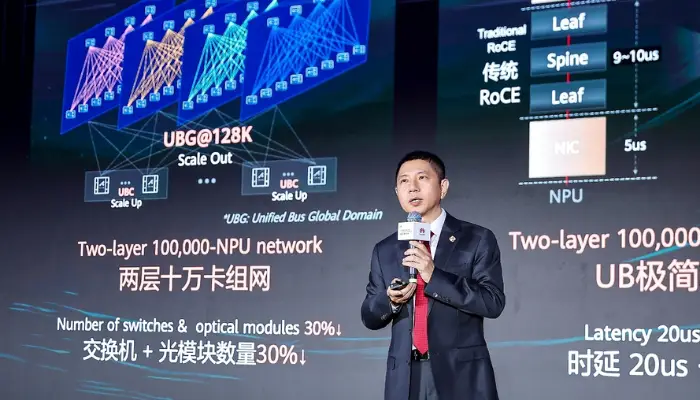
For AI data centre environments, Huawei has introduced the UBG switch SF9300 series, which can be paired with Ascend A5 and A6 processors to form an integrated computing and networking solution.
Huawei said a two-layer, multi-plane architecture removes the core network layer, reducing deployment costs by 30%. A unified protocol is designed to lower end-to-end latency from 20 microseconds to 11 microseconds, while Link-Layer Retransmission technology aims to prevent packet loss during link failures.
The company said the technology could reduce annual cluster service downtime by 100 hours.
Huawei also unveiled its CloudEngine XH9300-EN series of near-packaged optics (NPO) switches. The switches use a centralised light-source design that Huawei said reduces interconnect power consumption from 1,000W to 600W. The near-packaged architecture is designed to reduce optical-electrical conversion latency by 180 nanoseconds and improve single-node latency by 26%.
A pluggable snap-fit structure is intended to allow on-site replacement, reducing fault recovery time from days to hours.
Security measures for AI infrastructure
Huawei’s Three-Layer Security Guardrail Solution is designed to address threats including cryptojacking, prompt injection and model poisoning.
Its Network Guardrail includes a cryptojacking detection model that Huawei said achieves a 95% detection rate, with malicious traffic blocked within milliseconds. Agent Guardrail is designed to detect prompt injection attacks with 95% accuracy and latency below 150 milliseconds.
Host Guardrail monitors potentially malicious processes in real time while keeping CPU usage below 1%, according to the company.
Huawei said that, during the first seven days of deployment at a customer site, the solution identified 415 high-risk vulnerabilities and 322 threat events.
Stellar AI WAN supports distributed computing
Huawei’s Stellar AI WAN Solution is designed to improve the delivery of computing resources between locations, addressing challenges such as reduced efficiency, high on-premises costs and the expense of private network connections.
The company said its Starnet lossless algorithm can eliminate packet loss over long distances and support remote computing efficiency above 95%, including across distances of more than 1,000km.
The solution also includes an XH computing-network appliance that uses layerwise model partitioning to run a model’s initial and final layers locally, transmitting high-dimensional vectors across the network. Huawei said this approach keeps raw data on-premises and reduces initial branch xPU costs fourfold.
A computation-communication overlap mechanism is designed to reduce bandwidth idle time by more than 80% and cut required bandwidth by a factor of five.
WAN security and data protection
Huawei’s multi-dimensional WAN defence technology is designed to address threats including advanced persistent threats (APTs) and harvest-now, decrypt-later (HNDL) attacks.
At the device layer, security boards are intended to block intrusions in real time and trace threats within minutes, with accuracy above 95%. The system can also visualise attack paths spanning up to 100 hops.
At the link layer, built-in quantum key distribution (QKD) provides quantum security without additional devices. Huawei said this can reduce construction costs by more than 60% and extend transmission distances to 80km.
At the network layer, APN6-based data fencing controls traffic paths to support the secure movement of sensitive data.
Campus network upgrades focus on autonomous operations
Huawei has also upgraded its Stellar AI Campus Network to support more autonomous network operations and improve security across enterprise environments.
The company said its network awareness technology can collect more than 25 types of data at a sampling interval of 100 milliseconds to identify anomalies. Its Deep Causal Pruning algorithm is designed to reduce AI inference errors by more than 20% and improve troubleshooting accuracy to 95%.
The solution also uses iFlow 2.0 distributed simulation technology to continuously verify inference paths. Huawei said these capabilities can reduce mean time to repair (MTTR) to less than five minutes while supporting round-the-clock network operations.
For campus security, Stellar AI Campus Network Asset Security 2.0 uses endpoint and network collaboration to detect threats from devices and AI agents. Huawei said embedding AI micro-models in switches can reduce threat detection time for devices with limited security capabilities from five minutes to under 10 seconds.
The system also uses AI Core small models and NPU semantic large models to reconstruct agent interaction scenarios, with Huawei reporting a 95% malicious command detection rate.
Huawei said it will continue developing its Stellar AI Network products and solutions under its “AI for All, All on Secure IP” vision, working with customers and partners to expand connectivity capabilities for AI-era applications.