
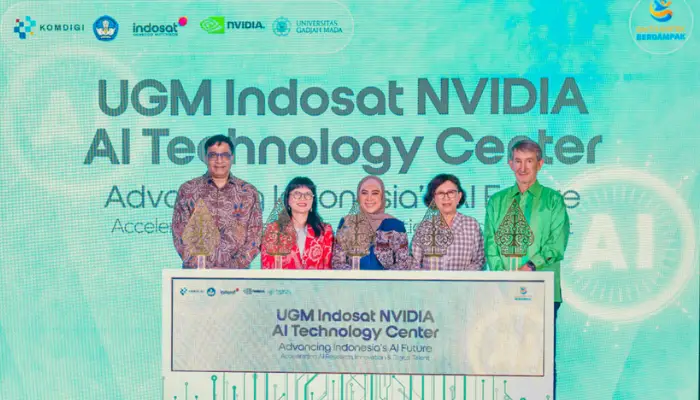
Indonesia – Indonesia’s Ministry of Communication and Digital Affairs (Kemkomdigi), Indosat Ooredoo Hutchison (Indosat/IOH), NVIDIA, and Universitas Gadjah Mada (UGM) have officially opened the UGM Indosat NVIDIA AI Technology Centre (NVAITC), the country’s first university-based AI technology centre focused on research, innovation, and digital talent development.
The centre was established under Indonesia’s AI Centre of Excellence (AI CoE) initiative, a program designed to bring together government, global technology firms, industry, and academia to accelerate applied AI research in sectors deemed national priorities.
A National AI Sovereignty Push
Speaking at the launch, Meutya Hafid, Minister of Communication and Digital Affairs of the Republic of Indonesia, framed the centre as part of a broader strategy to shift Indonesia’s role in the global AI landscape.
“The Indonesia AI Centre of Excellence reflects our long-term vision to position Indonesia as a nation that not only adopts AI, but also develops and contributes AI innovations to the world. This centre is an important milestone in realising that vision by strengthening our capabilities in research, talent development, and technological innovation,” he said
“Through initiatives like this, we are laying the foundations of Indonesia’s AI sovereignty and ensuring AI becomes a driver of economic growth, national competitiveness, and solutions to Indonesia’s most pressing challenges,” Hafid emphasised.
Infrastructure: NVIDIA’s Stack Meets Indosat’s Sovereign GPU Platform
The centre runs on NVIDIA’s full-stack AI platform combined with GPU Merdeka, Indosat’s sovereign GPU-as-a-Service platform. Together, the infrastructure is intended to give UGM researchers and students access to accelerated computing, AI software, pretrained models, development frameworks, technical mentorship, training, and industry partnerships — while linking them to an international network of AI expertise.
Vikram Sinha, President Director and Chief Executive Officer of Indosat Ooredoo Hutchison, said the initiative is aimed at broadening access to AI tools across Indonesia’s research and innovation community. “At Indosat, we believe no Indonesian should be left behind in the AI era,” he noted.
“Through UGM Indosat NVAITC, we are bringing the best of global AI technologies and expertise to Indonesia, while expanding access for the ecosystem of researchers, students, startups, and innovators across the country. By strengthening AI readiness and empowering Indonesian talent, we aim to support the government’s vision for AI and help position Indonesia not only as a user of AI technologies, but as a nation that develops and contributes AI innovations to the world,” Sinha also added.
Moreover, NVIDIA’s Marc Hamilton, Vice President of Solutions Architecture and Engineering, pointed to the scale of talent the company sees in Indonesia as a driver behind its involvement. “Indonesia is home to an extraordinary community of researchers, developers, and innovators with the potential to shape the future of AI,” Hamilton said.
“From healthcare and agriculture to disaster preparedness, the opportunities for AI to drive real change are immense. Through UGM Indosat NVIDIA AI Technology Centre, NVIDIA is committed to equipping Indonesian talent with the world’s leading open models and expertise to turn that potential into innovation with local and global impact,” he added.
Three Pilot Projects Target Health, Agriculture, and Disaster Response
Drawing on UGM’s multidisciplinary research base, local datasets, and pipeline of researchers and students, NVAITC will operate as a hub for applied AI development, starting with three projects tied to national priority sectors:
- eNose-TB — an AI-powered screening tool to support tuberculosis detection efforts in Indonesia.
- SmartAgri — a system combining multimodal AI, edge computing, and precision farming techniques to improve productivity and resilience in tropical agriculture.
- Tech4Disaster — a geospatial AI platform intended to strengthen disaster prediction, preparedness, and response.
Prof. Dr Ova Emilia, PhD, Rector of Universitas Gadjah Mada, said the centre extends the university’s role in applying research to national challenges.
“UGM is committed to supporting Indonesia’s AI ambitions through education, research, and innovation that deliver real societal impact. Through UGM Indosat NVAITC, we are expanding access to advanced AI infrastructure and global expertise for students and researchers, while strengthening interdisciplinary collaboration in strategic areas such as healthcare, agriculture, and disaster resilience,” she said.
“This initiative supports national priorities in higher education, research downstreaming, and talent development by accelerating the adoption of AI and preparing future-ready Indonesian talent,” Emilia highlighted.
In addition, Dr Dian Kesumapramudya Nurputra, M.Sc, PhD, SpA, a lecturer at UGM’s Faculty of Medicine Public Health and Nursing and lead researcher on the eNose-TB project, described the practical impact the centre’s resources are expected to have on ongoing research.
“As researchers, we have always believed that technology developed in Indonesia can solve Indonesian challenges. Through the centre, access to world-class AI infrastructure and expertise will help us accelerate our research and bring us closer to our dream of developing affordable and accessible healthcare technologies that can improve lives across Indonesia,” Nurputra said.