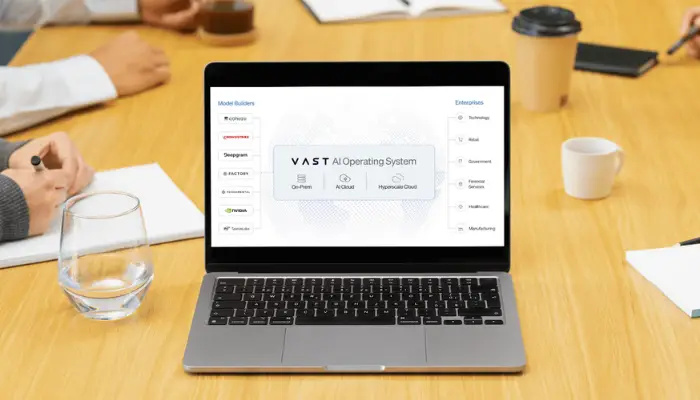


Seoul, South Korea – Hyundai Motor Company and Kia (HKMC) have made a strategic investment in VAST Data, extending a relationship in which the carmakers’ driver-assistance and robotics AI work already runs on the VAST AI Operating System (VAST AI OS).
The group’s autonomous mobility division and global software centre, 42dot, has run Advanced Driver Assistance Systems (ADAS) research and autonomous driving workloads on the VAST platform in production, according to VAST.
Before standardising on VAST, HKMC’s ADAS and large language model programmes sat on disparate platforms from different vendors. VAST said this fragmented data and duplicated effort as both programmes scaled.
42dot then consolidated the two onto an NVIDIA DGX SuperPOD powered by NVIDIA Hopper and built on VAST, bringing ADAS and LLM development onto a single data platform. As 42dot standardises its AI data structure and builds a Data Flywheel system, VAST says the platform accelerates model training and deployment.
In production, the environment has delivered a 2:1 data reduction rate on real sensor and video data, VAST said. The company added that its footprint and power efficiency have let 42dot expand capacity within existing data centre constraints.
VAST also said its multiprotocol support, including S3 and NFS, lets simulation, training and validation pipelines work against the same namespace without copies. The platform, it added, replicates 42dot’s AI datasets across the division’s data centre sites.
The investment comes as autonomous vehicle software becomes one of the most data-intensive workloads in enterprise AI. A single sensor-equipped test vehicle generates terabytes of data per day across cameras, LiDAR, radar and ultrasonics, and VAST said a global fleet can reach hundreds of petabytes under management.
Those workloads also pull the same platform in different directions. Raw sensor data, randomised video clips, validation workloads, model update syncs and real-time telematics each demand different throughput, latency and governance characteristics.
VAST says its Disaggregated Shared-Everything (DASE) architecture is designed to keep GPU fleets fed at that scale. It claims the design avoids the data fragmentation and I/O bottlenecks of legacy high-performance computing (HPC) file systems.
Explaining HKMC’s reasoning, Hokeun Chung described the investment as a continuation of the group’s role as a VAST customer.
“Our journey with VAST started as a customer,” said Executive Vice President Hokeun Chung of HKMC’s Future Strategy Division.
“Consolidating our ADAS and language model development onto one platform changed how quickly our teams can move from data collection to a validated model. Our work in autonomous driving and robotics depends on being able to use the data our vehicles generate quickly and reliably, and as data volumes grow it requires infrastructure that can keep pace. This investment reflects our confidence, earned in production, that VAST is the right long-term partner for that scale,” Chung discussed.
For its part, VAST Data’s leadership pointed to the wider physical AI sector.
“The companies building physical AI such as vehicles, robots and machines, are running into the same data problem enterprises hit years ago, and at a much larger scale. We remain committed to breaking decades-old trade-offs to deliver the data infrastructure stack for AI. HKMC’s decision to invest in VAST, having already seen the benefits of our technology, shows that our infrastructure is core to their future and capable of meeting the increasing needs of AI,” said Renen Hallak, Founder and CEO of VAST Data.
The deal follows VAST’s Series F financing, which closed at a US$30 billion valuation in April 2026. Investors in that round included Fidelity Management & Research Company, NEA and NVIDIA, and HKMC now joins VAST’s base of strategic and financial backers.