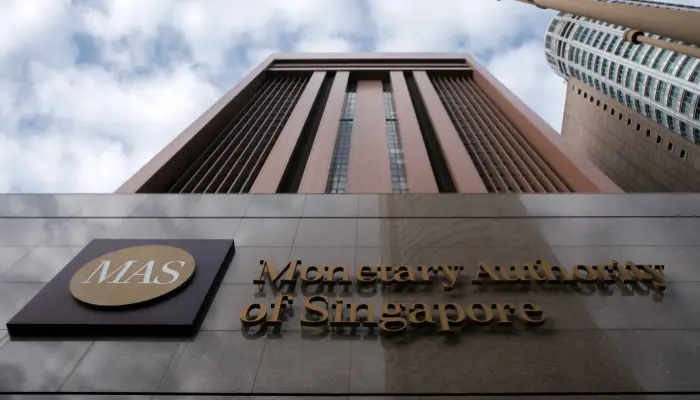


Singapore – The Monetary Authority of Singapore (MAS) will work with the People’s Bank of China (PBC) to split its Renminbi (RMB) facility into two separate arrangements, as both countries expand financial cooperation.
MAS announced the move on 23 November at the 22nd Joint Council for Bilateral Cooperation (JCBC) meeting in Singapore. Singapore Deputy Prime Minister and Minister for Energy, Trade and Industry (Trade) Gan Kim Yong and Chinese Vice Premier of the State Council Ding Xuexiang co-chaired the meeting.
The existing MAS RMB Facility, which is backed by a bilateral currency swap arrangement between MAS and the PBC, will become an RMB Corporate Facility and an RMB Liquidity Facility. MAS said the change responds to growing demand for RMB financing in the region.
Under the Corporate Facility, eligible financial institutions will be able to finance a wider range of activities. These include trade financing with third countries, working capital and capital expenditure, with a range of tenor options. The facility can also support intra-group funding for those activities.
The Liquidity Facility, by contrast, will continue to provide backstop RMB funding to eligible financial institutions in Singapore. MAS said this supports financial stability in the offshore RMB market.
MAS will also broaden the collateral accepted under both facilities. Singapore Government Securities (SGS) and MAS Bills will join Singapore Dollar cash, while MAS and the PBC are exploring whether to accept China Government Bonds.
Beyond the facilities, the two sides outlined cooperation in three further areas. On payments, MAS and the PBC are exploring a link between their fast payment systems for small-value transfers.
In capital markets, MAS and the China Securities Regulatory Commission (CSRC) will support enterprises seeking listings and fundraising in each other’s markets. They will also back new indices and additional exchange-traded fund (ETF) products under Singapore Exchange (SGX) cooperation with the Shanghai and Shenzhen stock exchanges.
On regulation, MAS and the National Financial Regulatory Administration (NFRA) agreed to deepen cooperation in banking and insurance through regular exchanges and training programmes. MAS and the CSRC will continue securities and futures exchanges, including staff exchange arrangements.
Financial institutions in both countries are also building direct links. DBS Bank, Singapore’s second RMB clearing bank, has begun clearing services to support the use of RMB in economic and investment activities in the region.
In addition, Bank of China (BOC) Singapore Branch has been included as an MAS Primary Dealer, a status that will strengthen its role in Singapore’s government securities market. Under an over-the-counter bond market arrangement, BOC and DBS have onboarded clients for the trading and custody of selected onshore RMB bonds in Singapore.
On investment products, SGX and the China Foreign Exchange Trade System (CFETS) will cooperate on Panda Bond listings in Singapore. ICBC Singapore and CGS International Securities have also launched the CGS-ICBC-CFETS Belt and Road Bond Index ETF on SGX.
Chee Hong Tat, Minister for National Development and Deputy Chairman of MAS, commented on the measures. He said, “Singapore and China have made tangible progress to strengthen cooperation and markets connectivity. This year’s measures build on this progress, by exploring new areas of cooperation, alongside stronger commercial partnerships between our financial institutions. Together, these efforts will facilitate growing financial flows and support trade and investment linkages between our two markets.”