
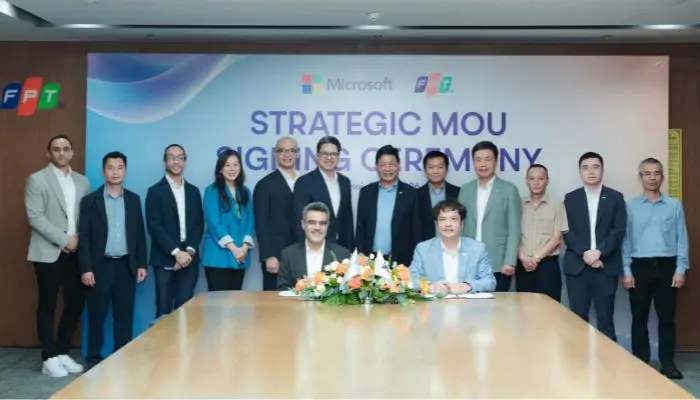
Vietnam – FPT Corporation has expanded its strategic collaboration with Microsoft, with the two companies aiming to accelerate enterprise AI adoption and support large-scale AI transformation programmes across ASEAN, Japan, and South Korea.
The expanded partnership combines Microsoft’s AI platforms with FPT’s delivery capabilities and regional presence to help organisations move beyond AI experimentation and scale adoption across business, operational, and engineering functions.
As part of the collaboration, FPT will work with Microsoft as an AI Frontier Company, a model that focuses on integrating AI agents into day-to-day workflows and core business processes. The initiative will involve early access to emerging AI technologies, joint development of generative and agentic AI use cases, and the creation of reference architectures and industry solutions designed for enterprise-scale deployment.
The partnership will also see FPT continue adopting Microsoft technologies as part of its internal AI transformation efforts, particularly through Microsoft 365 Copilot and GitHub Copilot. Over the next three years, the company plans to equip up to 20,000 developers with agentic development capabilities as it expands AI-enabled engineering practices across its workforce.
Beyond technology adoption, the collaboration establishes a structured “Pathfinder” approach to strengthen joint engagement across key Asian markets. This framework includes executive sponsorship, governance mechanisms, investment initiatives, and coordinated go-to-market activities, alongside capability-building programmes for leadership, sales, and delivery teams.
Both companies said they will focus on developing AI adoption models that can be replicated across industries, helping enterprises transition from isolated pilot projects to broader AI deployments supported by Microsoft’s technical resources and FPT’s implementation expertise.
The collaboration also extends to supporting Vietnam’s broader AI ambitions. Areas of cooperation include capability-building initiatives, ecosystem development, thought leadership programmes, and the development of policy-aligned frameworks intended to support AI adoption in line with national priorities and regulatory requirements.
Mayank Wadhwa, President of Microsoft ASEAN, said, “Vietnam is stepping into a pivotal phase of AI adoption, where organisations are ready to scale beyond pilots and redesign how work gets done. AI frontier organisations, human‑led and agent‑operated, will define this next chapter. By combining Microsoft’s trusted global AI platforms with FPT’s large-scale capabilities and deep engineering strength, we are helping Vietnamese enterprises accelerate this transformation with safety, responsibility, and real impact.”
FPT and Microsoft have worked together since 1996 on projects spanning e-government systems, taxation, customs, healthcare, and enterprise modernisation. Over the years, the relationship has expanded to include cloud, AI, and digital transformation initiatives for enterprises across global markets.
FPT currently has more than 3,000 Microsoft-certified engineers and holds specialisations in artificial intelligence, machine learning, and Kubernetes on Microsoft Azure. In 2026, it became the first Microsoft Enterprise System Integrator in Southeast Asia to receive Frontier Partner designation, recognising its capabilities in delivering AI and cloud transformation projects. The company was also recently named a Microsoft AI Discovery Cards Featured Partner.
Separately, FPT recently introduced FPT CASAN, an AI transformation methodology designed to help organisations assess readiness, strengthen governance, and scale AI adoption across business functions through a structured five-level framework.
“As enterprises move from AI experimentation to enterprise‑wide adoption, the challenge is no longer technology alone — it is scale, resilience, and execution,” said Nguyen Van Khoa, CEO of FPT Corporation.
“Through our deepened collaboration with Microsoft, FPT is enabling global enterprises to accelerate AI transformation across different stages of maturity — from early exploration to AI‑enabled workforce productivity and upskilling, to the integration of AI into core processes and fully AI‑native operations — strengthening cybersecurity readiness, accelerating cloud and recovery architectures, and improving cost efficiency through productivity‑led digital and AI transformation. We are committed to enabling clients to move faster, operate more intelligently, and scale AI capabilities wherever their business operates.”