

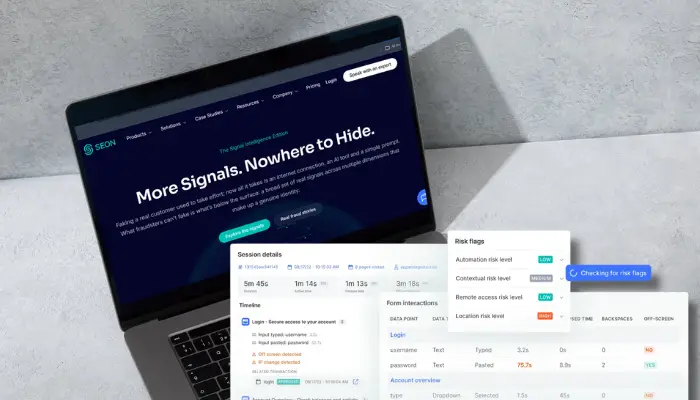
Singapore – Fraud prevention platform SEON has expanded its signal intelligence framework from more than 900 to over 1,100 proprietary data signals, the company announced on 17 September. The expansion adds coverage across address intelligence, session behaviour, phone and carrier data, digital footprint and device signals, according to SEON.
The move follows warnings from industry bodies about the rising use of generative AI in identity fraud. According to the (FATF), anyone with a smartphone can generate a convincing deepfake in roughly the time it takes to set up a social media profile.
ACAMS reports that 75% of anti-financial crime professionals have ranked GenAI misuse as their top emerging risk for three consecutive years. SEON said fraudsters can now use AI agents to produce believable identity profiles and consistent device histories within minutes, a process that previously required manual assembly of evidence.
SEON said individual data signals, such as an email, device or address, can each pass validation on their own. The company said fraud typically becomes visible only when such signals are checked against one another.
The expanded signal set covers three categories: historical footprint, connected infrastructure, and live behaviour. SEON said the additional data feeds into decisions made through rules engines, human analysts and AI agents on its platform.
Digital footprint checks now trace where an email or phone number has appeared across a wider range of services, including AI developer platforms, job boards, real estate sites and dating apps, according to SEON. Phone intelligence has been expanded to include SIM-swap and porting history.
Address intelligence now standardises and verifies address strings across more than 240 countries, assigning identifiers to specific addresses and buildings, the company said. SEON said this allows detection of cases where separate accounts are linked to unit-number or formatting variations at the same physical location.
Device intelligence has been expanded to surface AI-agent activity, compromised iOS devices, Android eSIM mismatches, and discrepancies between a device’s network country and a VPN-masked IP address, according to SEON.
Session monitoring tracks customer activity from onboarding through login, account recovery, checkout and payment. SEON said this is intended to help detect automation, remote access, off-screen activity and active calls during a session.
The new signals are accessible within SEON’s AI Command Centre for use in rules, alerts, customer reviews and network investigations, the company said. The signals are also available through SEON’s Model Context Protocol (MCP) server, which connects to external AI tools used by investigators.
“AI has made a believable identity cheap to produce. What fraudsters cannot easily do at scale is build a consistent history for every account without reusing infrastructure,” said Tamas Kadar, CEO and Co-Founder of SEON.
“That is where our signal foundation makes the difference. The more dimensions a fraud team can check simultaneously, the harder it is to hide an identity that does not add up,” Kadar continued.
SEON has also launched a series called Hidden Risk Files, featuring investigations written by its fraud consultants. The company said the first instalment describes how a single device attribute, a screen-brightness reading, was used to link thousands of accounts within a fraud ring operating on Android hardware.